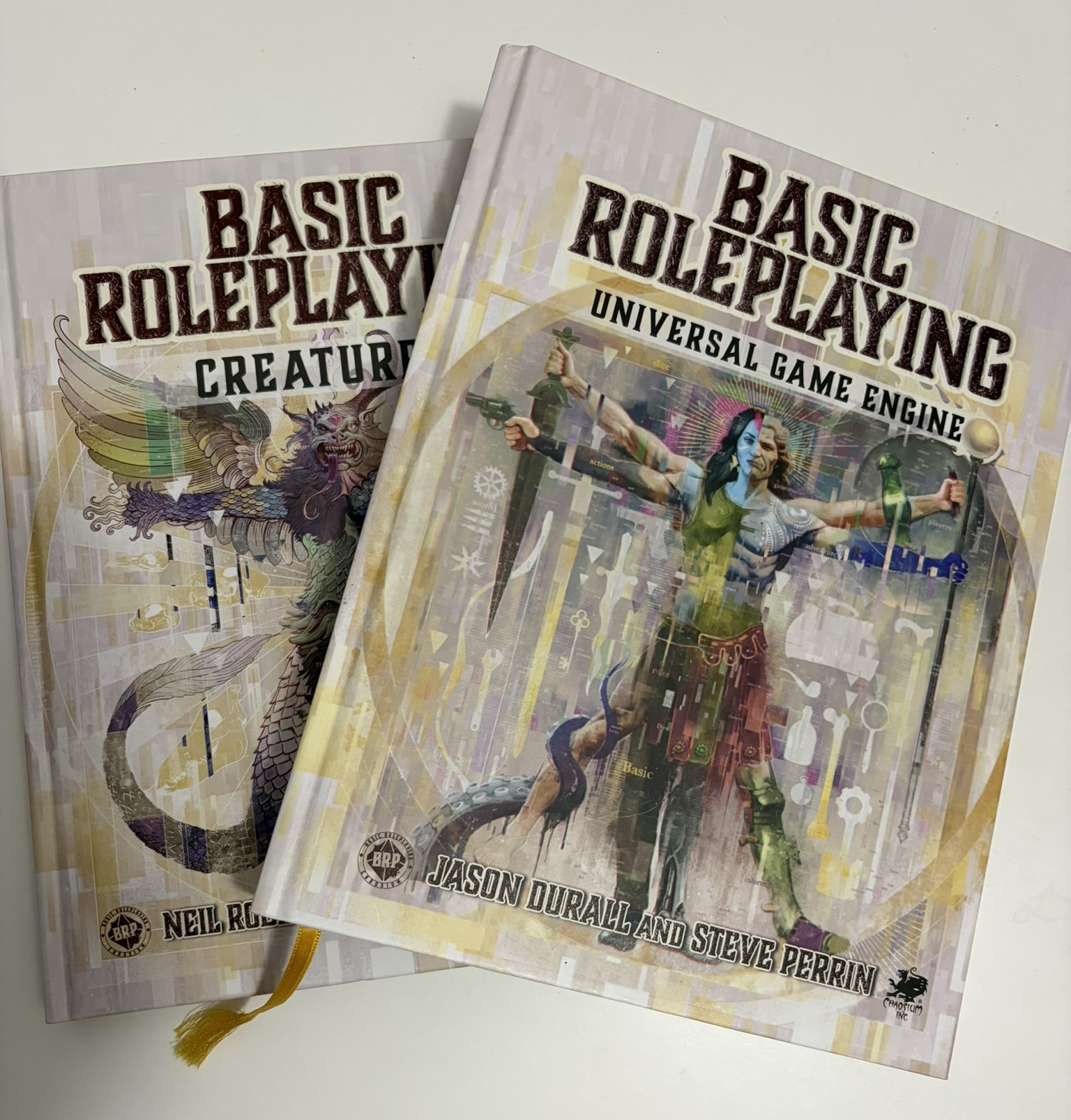
In a lot of ways, this review will be more like the others I’ve done: I’ll focus on bits and pieces I think are important for my style, and the genres of RPG that I like, which I talked a bit about here.
Basic Roleplaying is one of the venerable games of our hobby. It’s been around since the first Runequest game came out in 1978, and has iterated itself as a system through a wide variety of games, including the aforementioned Runequest, and Call of Cthulhu which many of you will know, into a lot of side games in its early heyday like Elfquest and Stormbringer (and the dear to my heart Nephilim). Runequest was quite literally my second roleplaying game after a few editions of D&D (if I remember, I got RQ3, back in 1990, and it blew my mind after playing D&D for the first three years of my gaming career; after that came Traveller, but it’s entirely possible I have the order wrong so don’t quote me on that – suffice to say, I picked up both games somewhere in the same year).
So I want to review it today, because it’s coming back in style (though never truly out of style) and its on my mind more and more as I look for a game that hits the sweet spot for me of enough rules to hang my hat on, but not so many I drown in the details (dragging my players along with me). As I’ve mentioned before, I’m very much a GURPS and Burning Wheel superfan, but even I want something different, that gives a different feel than those two games can.
What is Basic Roleplaying
As I stated above, BRP is an old game system. The basic roll (haha!) is percentile, so, you roll 2d10 (one die being the tens, another the ones) and look to get under your skill. There various levels of success and failure that can be generated by the dice, but basically, roll under your skill or other check, and you get what you want. Pretty simple, right?
There’s a bunch of other things to it, since this IS a legacy system, so there are a lot of little things that have been there forever that aren’t, say, as unified as they might be under some more recent game designs (for example, dice for damage rolls are completely different dice than used for skills in terms of percentile vs. d8s or d6s or whatever). However, these things are so minor, I don’t think any gamer will feel bad about them. Anyway, it’s a chance to use your other dice, so that’s nice.
Let’s Talk About Our Feelings
Actually, let’s talk about mine. Particularly when I’m talking about the feel of a game. As I’ve said elsewhere here in the blog, I’m very much a System Matters guy; to me, a system and how the rules work (and even things like the character sheet) shift our thinking and gameplay in subtle ways. Naturally, we react to how games do things, what rewards we get from playing the games in certain ways, etc. It’s why I’m a big fan of generic games, but I also understand that by necessity, a generic game isn’t “bland”; it has its own “flavor”, and that flavor, uh, peppers everything in the game to its “taste.”
For example, I’m a big fan of Savage Worlds. It’s a generic game, and it has some great, extremely useful sourcebooks for Fantasy, Science Fiction, and Supers. The sourcebooks are written in a way that you can use them to mimic any TV show, book or movie you’ve ever seen, or something that’ll work, mechanically, in whatever setting you want. However, SW IS a pulpy type adventure game; the mechanics point us in that direction (short, broad skill list, lots of abilities hidden within Edges, etc.). I’ve used SW for lots of things, but it is still a pulpy adventure game at the end. When I’ve tried (twice!) to use it for something Game-of-Thrones-esque, it fell flat each time, and I ended up switching to something else. Why? Because the game didn’t have the feel I was looking for, though the rules themselves worked fine and were, on their own, quite fun.
BRP, then, has its own feel, despite its generic nature. It’s been used in a LOT of different settings over the decades of its existence, and has had two serious attempts at generic versions. Where it shines, for me at least, is in low-magic, more gritty types of games.
How BRP Generates “Feel”
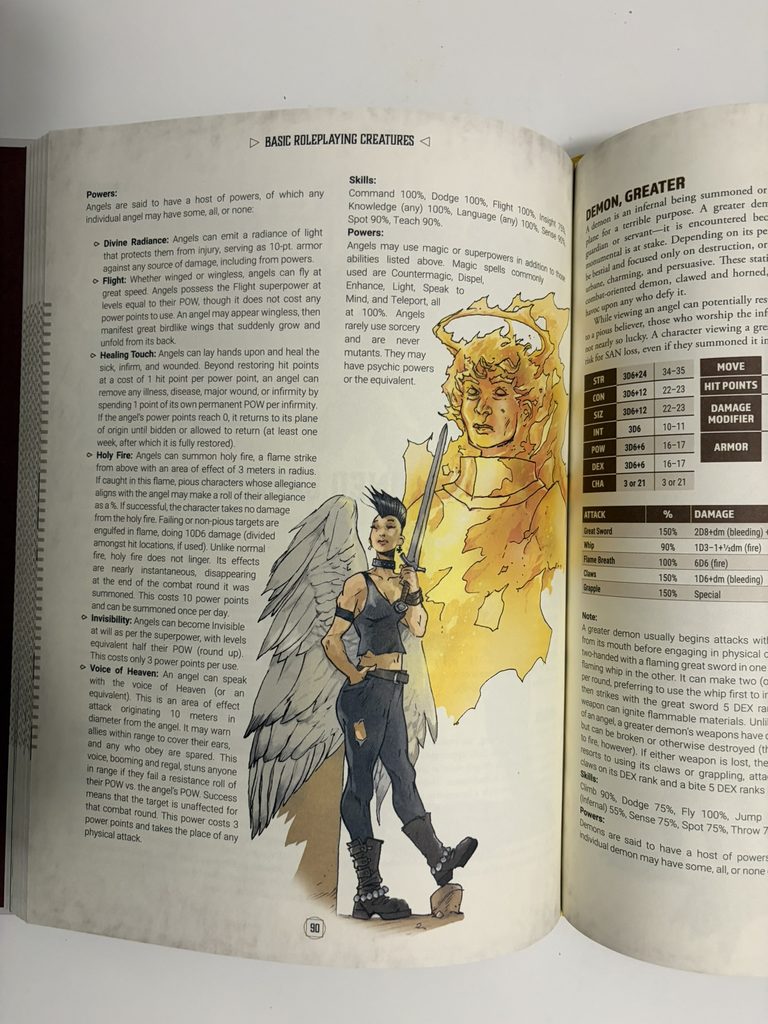
First of all, BRP is BIG on having a lot of skills. Like, seriously, a lot. It’s even called a skills-based RPG by some (me included). The list has 58 skills, and some of those skills have subskills that you must choose to specialize (so, the Knowledge skill has more than 20 of them, for example). That’s something a lot of games shy away from. But this means BRP games want you to have differences between using an axe or a sword or a spear – and having the ability to fight with one doesn’t mean the ability to fight with another.
BRP is also rather deadly, or at least, it’s easy to hurt PCs. Using the base system, a PC has maybe 10 hit points. A dagger does 1d4+2 points of damage; so, if you aren’t wearing armor, and you get hit twice, you’re down. Once you’re at minus HP, there’s only one way to survive – somebody heals you somehow enough to get to at least 1 HP (a successful Medicine or First Aid skill roll will do it, or magic or whatever is in your game world). So, combat tends to be fast and pretty brutal (most combats I’ve run in the system last 2-4 rounds, tops).
Another way BRP gives its own feel to games is in what it doesn’t have – Feats, Edges or Talents are mostly not present (there may be some variant out there I don’t know or remember, but for most BRP games, your character has Characteristics, Skills and Equipment, and that’s pretty much it). Obviously, if you’re playing a fantasy game, you might have a magic system or two, or psychic powers in a psionic agents game, but otherwise, that lack of gegaws and other dodads makes characters, to me, feel more “real” (which is a silly thing since we’re talking about a game here). It also makes them easier to deal with. The closest we get to special stuff are the Superpower rules, because the main book at least uses those super powers to mimic things like an Elf’s nightvision.
Easy to See Odds
This one’s obvious, but I think for some players it can matter quite a bit. Basically, you easily understand your chance of doing something. If you have a skill of 30% in your Axe, then, that’s your chance of hitting each time you roll the dice. Some games make this opaque or hard to see on purpose (look at Cortex Prime’s VERY interesting obscuring of the odds math, which very much seems to be on purpose by the author’s admission) but I think it’s a plus to know your chances exactly. It also saves the GM a lot of work, frankly – you can definitely give penalties or bonuses, or say this roll is Hard because the character is partially blinded, but the skills are meant to be rolled in most situations at their unaltered level.
Connection to Community
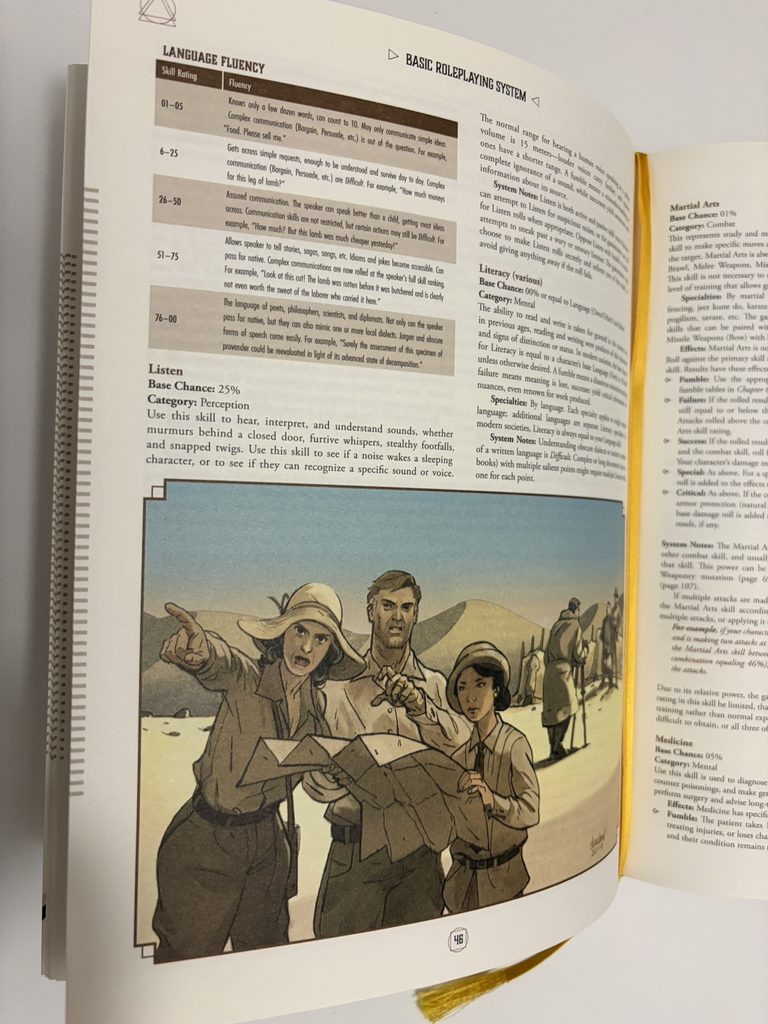
Now, this isn’t necessarily done in all BRP based games, but a lot of them have the PCs as people connected to their communities in some way. Runequest: Roleplaying in Glorantha assumes that PCs are members of a tribe or city or some other community that you care about and are tied to. In Pendragon, you’re a knight with lands and a lord above you and all the social connections that entails. In the Basic Roleplaying: Universal Game Engine book there are rules for Passions and Allegiances (and Reputations), all of which are things connected to who YOU’RE connected to around you.
This is a big deal for me. The rootless wanderer that does “missions” for well-heeled patrons is an old trope in gaming, and I know why it’s there. But for my own gaming, I prefer characters that are “grounded” somewhere. They belong, they are part of the furniture so to speak, and so, their actions and activities are rooted in that. I mean, trying to get rich is nice and all, but if it’s the ONLY motivation, for me, that gets stale, very, very fast. Even actual adventurers in our own world, who were definitely trying to get rich, had other motivations for what they did: to make a name for themselves, to move their family up in society, to create safety for their later life by making as much as they can now. All of those desires are rooted in being connected to a society that matters to you.
Advancing Stuff
Some nice folks online have reminded me of another key point I ought to bring up, since it’s quite different from the game we all start with, D&D (actually, it’s quite different than most games). In many BRP games, to Advance your stats or skills, there’s basically two options: one is training (which can be on your own or with a teacher). This is up to the GM to allow or provide, to work out costs for your character, but there is a system for it, either on your own as practice or with a teacher.
The second is much more interesting and I think, as I’ll say elsewhere, gives BRP a big push into the “realism” section. In BRP, skills advance when you use them. That is, when you use a skill in the game you put a check next to it. Then, at the end of the session, you roll to see if you learned anything. This roll is percentile (duh), and needs to be higher than your skill. So, if you have a 60% in Underwater Basketweaving, and you use it this session, at the end of the session, you’ll roll against that, hoping to get higher that 60%. If you do, you increase the rating by +1d6% usually (or you can just take +3% if you don’t feel you’ll do better). This is interesting because advancement isn’t an all at once thing in various abilities, even ones you’ve never used (as with most level-using systems) or a matter of spending points to buy up something (as in MANY non-leveling systems). You only advance if you use it in the game (or pay someone to train you, as we discussed before). So if you want to get good at something, you’ve got to try it for real in the game.
I don’t want to go into too much detail, but there are also ways to increase your characteristics, to learn new skills and spells and what not. And if you can’t do something through using it through experience (like a new skill) you can study (research) or, as mentioned, get a teacher or trainer.
The Case for Basic Roleplaying
Here, I’m talking in general. As I said before, there are plenty of games which use BRP as their engine (Runequest:RiG and Call of Cthulhu being the big ones, but there’s some smaller ones too like the game I’ll get in my hands soon, Age of Vikings). For me, BRP is a game I’d turn to if I have an idea that doesn’t really fit another game (though that works for any generic game), but more importantly, if I want the feel of a BRP game. As I’ve said elsewhere, I really like historical fantasy – BRP is perfect, since the gritty feel but generally easy rules are exactly what I’d want for that game. Honestly, every time I have a historical game in mind, it’s a toss up between GURPS, Burning Wheel and BRP. I think all of them approach gaming differently, and all bring unique things to a game. BRP isn’t perfect, certainly (a lot of the games I named above use Hit Locations, which I’m not fond of, though the base game makes that an optional rule) but it hits a nice sweet spot for me, letting me run what I want how I want, within the easy-to-grasp BRP framework. If it had a mass combat system it’d be even more in my rotation than it already is!
Well, that’s the end of that. As always, any commentary, ideas, or things you think I missed, let me know in the comments!