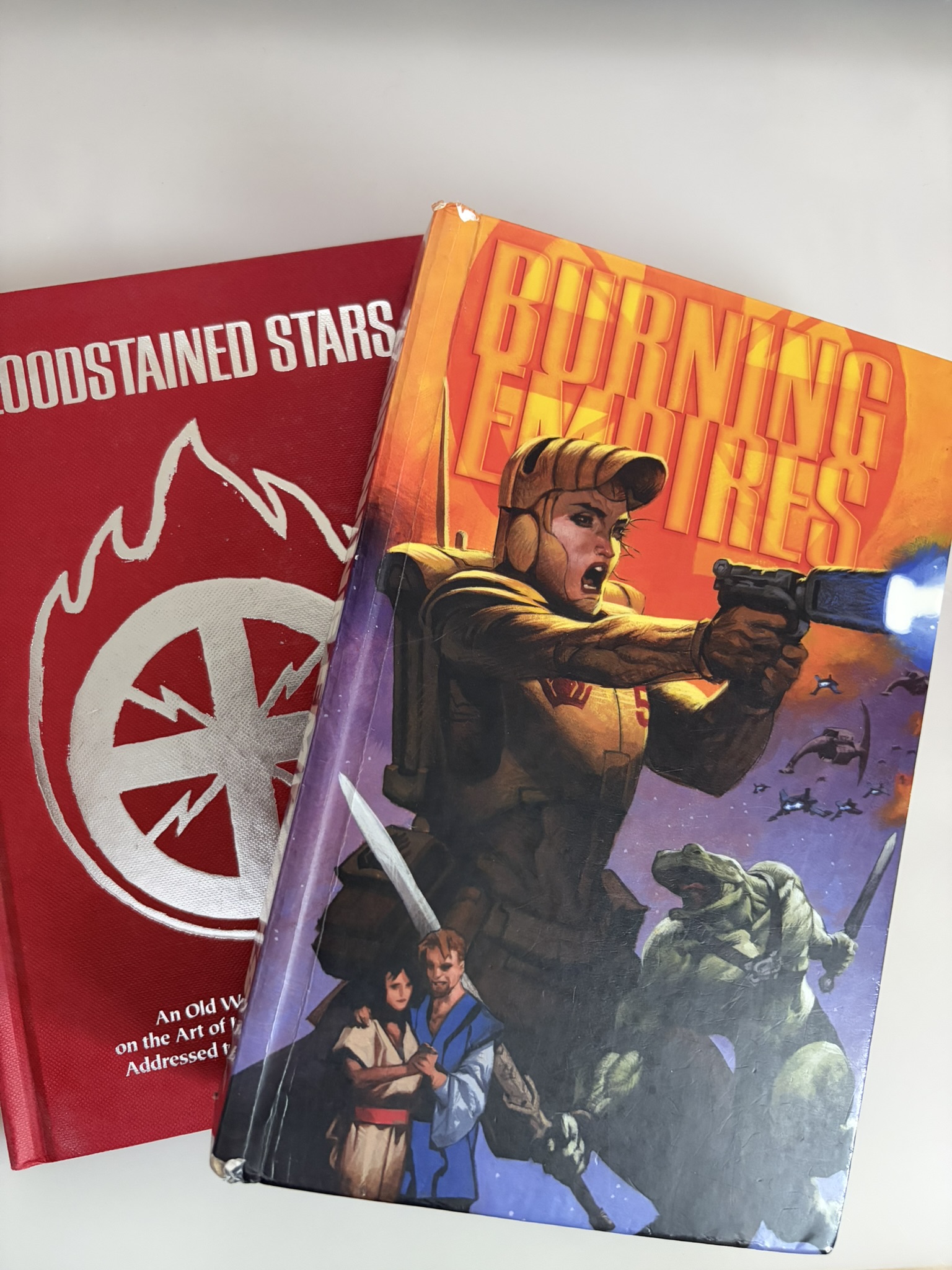
Burning Empires is the game that ironically got me to look at Burning Wheel more closely (I say ironically because I had owned BW, then SOLD it because it imploded my gaming group, then someone online gushed about BE – I bought it, fell for it, and re-bought BW, leading to my reawakening as a BW/BW/TB player). This game is also special to me because it made me really examine who I was as a GM, and what I wanted out of a game, and why I want it, etc. etc. I mean, GMs are players too, and have a certain experience in mind when they run a game, and things they want out of a game. This game made me zero in on what that is, and gave me ideas on how to examine it from time to time.
So, like my Burning Wheel review, this won’t be a classic review where I go page by page and explain all the rules and all that. Again, there are reviews of BE online (and frankly, most of the rules in this book are exactly like BW’s, so you can read a BW review too to get an idea of how the basic rolling, Beliefs, Instincts and Traits, and other things work).
What I want to talk about shortly (hah!) is what’s different. What makes BE not like BW, and what in this game pushed me, I think, to be a better GM all around.
What is Burning Empires?
First of all, for the uninitiated – BE is a science-fiction game based on the graphic novel by Christopher Moeller called the Iron Empires. In a nutshell, those stories, and this game, focus on the attacks of an alien parasite called the Vaylen, who seek to infect humanity so they can, in essence, bond with humans to live their best lives (the Vaylen can bond with other species, but humans are apparently “tastier” for the Vaylen, giving them a more vibrant living experience).
The PCs are assumed to be leaders of humanity on a particular world, and the Vaylen are trying to get in and take over to use humanity as their vessels. The game works in phases, and in each phase, the PCs are supposed to do actions to hold back the tide against particular enemies who are, consciously or not, helping the Vaylen cause. There are a set of mechanics (called Infection) which act as a complex clock for counting down the action – the invasion is happening, so the question is, can you slow it down/stop it or not?
This thinking, to me at least, seems to come from another BW game, a quite old supplement to Burning Wheel called Burning Sands Jihad. That supplement was Dune-with-the-numbers-scratched-off, and it’s premise was quite similar – in this case, you’re are members of the high command of a Noble world, fending off the Jihad of the newly created Emperor (in Dune terms, you are a noble family fighting for your world against Paul Atredies and his Jihad). It also had (an albeit simple) countdown mechanic was well, to track the success of the defense vs. the Jihad.
What This Game Does Differently
There’s actually quite a lot, and I’ve already touched on some of it above, but now I’ll go into more detail.
You Build the Setting Together
Between this game and Fate, I’ve including players in setting creation can yield great things. In BE, you actually have a set of lists of things to choose from for your planet, like Topography or Government type, which factions exist on the world, etc., which will determine the actual Lifepaths you can make characters from as well as the shape of the narrative.
My first BE group, for example, created a world where the main industry was based around a healing chemical you could only find on this world, making it quite important. The government was a feudal one, but the local Church was a major player (and landowner) in the setting as well. They also decided the world was harsh and cruel, locked in perpetual winter, with everyone living in dome habitants on the surface, or space stations above. It was quite evocative that the High Admiral was his Eminence, the Baron of L3, Knight of the Holy Healers.
Important from the Start, not Several Levels Later
First, for me, the big change was framing the PCs as important, right from the beginning. These aren’t farmers on a backwater planet who are swept up into adventure, or newbie soldiers sent on their first mission. You start the game as a mover and shaker, someone important to the setting, who leads someone, somewhere. In my first BE game, one guy was the leader of the planet, another his High Admiral, and a third the leader of the planet’s mafia (the fourth guy I had to push up – he just wanted to play a nobody merchant for some reason; I pushed a bit, and got him to be the elected representative of the planetary merchant’s guild, but it took some pushing!).
I’d already been running games this way in other systems, and some lend themselves to this (for example, in a recent Runequest game before I ran BE, one of the players became the chief of their clan; the other players were his Clan Ring). But Be is really one of the first that supposes you start that way. BW hinted that you could (it had lifepaths for military and court leaders and even royalty), but BE says “You’re it”. It even stresses that if you’re somehow not an actual leader, that you’re still a focus of the story and setting – your tribulations turn out to be pivotal to the Vaylen invasion one way or the other. I love this, and wish more games did it.
Phases of Action (the Clock is Always Ticking)
This is something I’ve tried to replicate elsewhere (for example, if I ever get around to trying to run the Pirates of Drinax again for Traveller, I DEFINITELY want something like this in the game). Shortly, there are three Phases of the Vaylen incursion (Infiltration, Usurpation, and Invasion). The following rules are called the Infection mechanics (meaning, do the Vaylen infect the world or not?).
For each Phase (which takes 4-12 sessions, another innovation since the game has a loose endgame in mind from the start) you have a goal, something big that you want to change in the setting (for example, eliminating one of the planetary factions, deposing the currently ruler for another, or changing the planet’s economic policy). You also have points called Disposition, which measure each sides’ closeness to being eliminated.
In each Phase, you have a series of Maneuvers (usually 8-24 depending on how you play), which VERY loosely measures you moving towards whatever goal you stated for the Phase, but understanding that there might be lots of steps to get there. At the end of a Maneuver, you roll some sort of Maneuver action, to see what happened in terms of Disposition (for example, you could try to Assess the other side to understand them and their forces or machinations (important for other actions), and then later Pin them (you do something so the enemy can’t act as freely as they wish, effectively making them roll less dice for the next Maneuver roll).
Now, all that’s fun and interesting and different. But now let’s dig into the REALLY innovative (to me) part: Scenes.
Scenes as the Currency of Maneuvers
This was the part that made me change how I GM for the better, and got me really thinking about what I was doing in game. At its base, the idea is that each player has a certain number of scenes they can initiate in each maneuver. These scenes are of different types (Conflict, Building Color) which I won’t get into, but basically, there are hardish limits to how many can be in a Maneuver. This does something interesting; it forces the players and GM to decide what’s important, what they must get done (the GM is bound by the same rules, by the way, since here the GM is sort of adversarial, in that they are playing the machinations of the Vaylen invasion). A player can’t lollygag around talking up every single NPC in the castle, because if they do that, they run out of Scenes, and then we roll the Maneuver and maybe they didn’t get anything done by then. To Help each other in rolls for the Maneuver, for example, PCs have to have Scenes with each other, so eventually everyone gets included and no one gets to be a loner loner-ing in the corner in a longer-ly way. Either they’re in, or they’re out of the action.
For me, this was revelatory. In most games, we just sort of have scenes until the GM decides to stop chewing the scenery, or letting the players “click on each pixel” to get the maximum preparation and benefit from everything. There’s nothing wrong with this, mind, but the game really reinforces the whole “it’s an alien invasion on their timetable.” The clock is ticking, the Vaylen are coming. Each maneuver happens after a certain number of scenes, no matter what. The story moves forward. What will you do?
This made me focus as a GM. Each scene had to have meaning, even from my side. I noticed, when I ran BE, my NPCs were MUCH more aggressive. I did lots of “Lord Amber is calling for a meeting of the Council to demand an attack on [insert Players’ ally here].” In the past, I’d telescope it – PCs would hear whispers, they’d inevitably investigate, try to line up support, and on and on. They’d somehow maximize time in a way no human could (this is another issue to discuss in another post – why do we let players control their time so precisely, when in real life, we can’t even get them to come to sessions on time?). Everything took time. In BE, there is no time. If I want my NPCs to hinder the players, they’ve got to GET ON WITH IT.
This has definitely bled over into my other games. I’m a lot more pushy and open about what I’m doing now. I get on with it. Ambushes happen right after other scenes. I know plan one or two THINGS to happen during travel; if I don’t have a plan, I just ask “Are you doing anything in particular? No? Then you arrive at the city after a 10 hour orbital flight” and move on. I work very hard to make scenes have meaning now (before, I’d sort of meander from thing to thing as we talked; BE made me stop indulging this behavior).
This also connects to another principle I mentioned in my Burning Wheel review – radical transparency. Everyone should know what the heck is going on, and I include players in that. I tell them straight: “Based on what you hear in the King’s court, these guys are trying to get you kicked out; what do you want to do?” Again, in the past, I’d stretch that out, let them discover it – I do understand that is some of the point and fun for some players; they WANT to chew through the scenery and poke at every NPC until they feel they understand something very deeply. But that isn’t the way I run anymore. I’ve had players stop gaming with me because of it; I wasn’t into lengthy, florid, long descriptions and character studies and speculation anymore. I kept pushing (reasonably I hope, but yes, pushing) for people to get on with it. Commit. Make a decision. Act.
Which I’m sure didn’t make me fun for some people, as said. BW does this to an extent as well, mind, but BE REALLY honed in on that conceit – there’s no time, get moving. In most of my game now, I also try to build lots of pressure cookers. Things have time limits before the enemy does something (and following radical transparency, I try to be pretty upfront about what that is and when its going down). I know some games do this with Fronts or something like it (Fate sort of does, for example) but BE opened my eyes to it.
It also means I’m very clear that PCs be built to DO STUFF. Meaning, you’re not just making a character to play in the game, you’re making a person that’s going to meaningfully contribute to the story and setting and so on; they’re made so they’re a part of things, and so are going to act to protect/change/whatever the setting and people in it. Oddly, I’ve noticed in a lot of games, you just make a character – they’re there, and, yeah, that’s it. But even in games like Old School Essentials, I insist on it: who is this person? How do they fit? What’s their role in society? As a GM this helps me a lot, honestly, to give characters challenges, or at least engage the player a bit.
The Adversarial GM (sort of)
This flies in the face of most GM theory, but the game also has the GM act as a foil for the characters, and in the Maneuvers and Phases, you are, actually, trying to win. This means there are some rules you must follow as the GM (as mentioned above, for example, you also must conform to the scene economy of the game). You also must “burn” the main nemesis characters of the enemy side, and use their stats when you make their maneuver rolls and the like. No other game I know of does anything like this, where the GM is, actually, out to get the characters.
There’s More!
Except I won’t talk about it. Suffice to say, BE is chock full of good things and good practices. As mentioned above, BE has given me plenty of tools that I use elsewhere. It also taught me to be a better, more to the point and sharper GM. I think this has improved my games overall.
Hope this gave some of you an idea of what Burning Empires is, and why it remains one of my favorite games, despite the fact that it isn’t even slightly generic in the way BW is (and usually, I gravitate towards generic or universal games anyway).
As always, there are more articles that I’ve written, which you can have a look at here: Articles