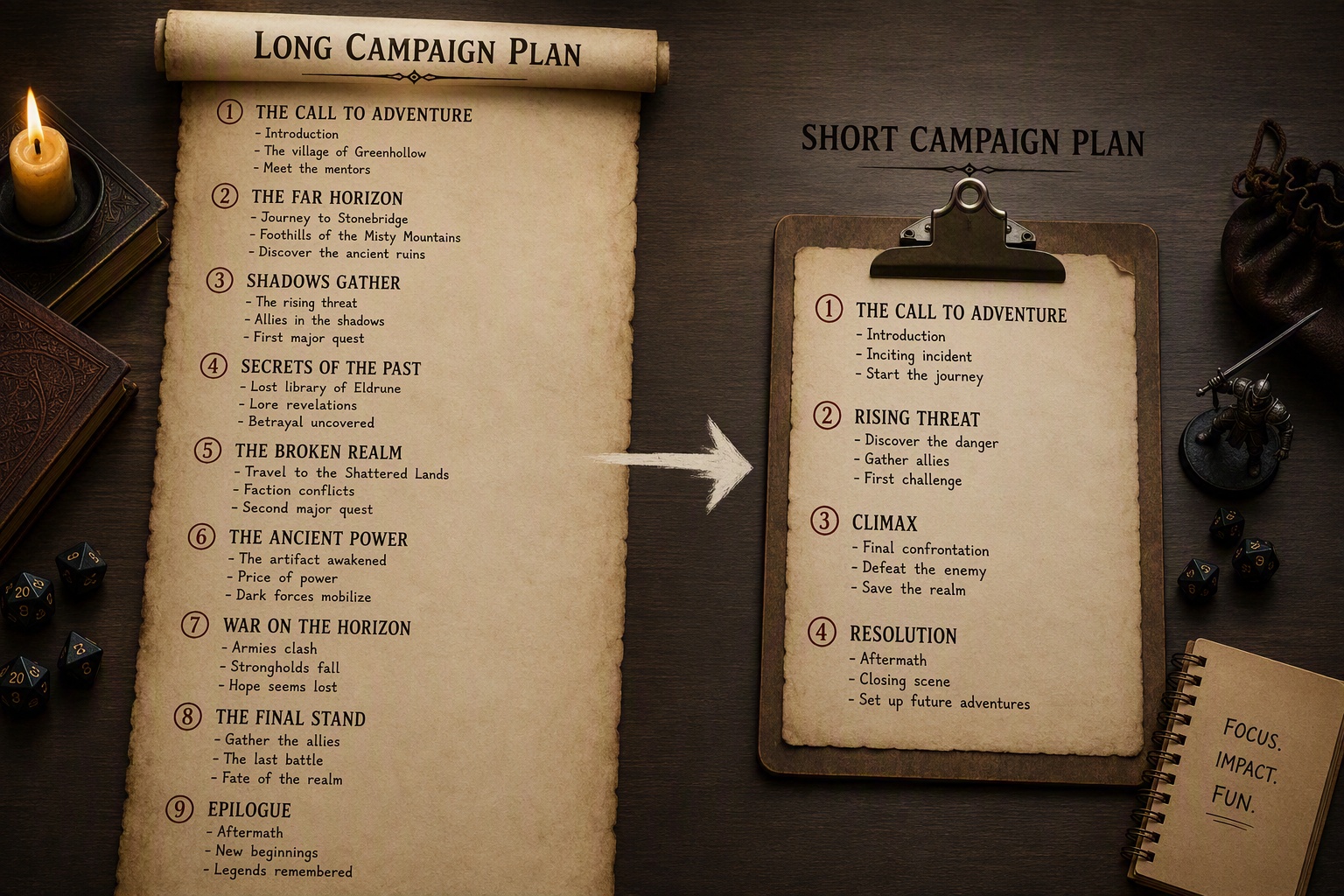
The Bog Standard Way
It’s a truism in much of the tabletop RPG hobby that you basically pick a game and play it until everyone gets tired of it. We have plenty of stories of people playing one game (and one continuous campaign or setting) for a year or more (and the crazies who run multi-decade campaigns). It is also a truism that we should be playing once a week for 3-5 hours, so, these long campaigns have long legs indeed; upwards of 40 sessions a year and so on, for more than 120 hours.
Lots of games lean into this model. The granddaddy, D&D in all its iterations, assume a “zero-to-hero” progression, which fits perfectly with the idea that you’re going to have 40-50 sessions a year, allowing a long line of progression from farm boy to hero of the kingdom. It wouldn’t be fun, after all, to promise lots of cool powers and abilities and never see them in something like a reasonable timeframe. Most Basic Roleplaying games (like Runequest or Call of Cthulhu) work this way as well – you might start out with a few skills in the 40s to 50 range, maybe one or two above that, and start playing. Usually, skills advanced (if you used them meaningfully in the session) at the rate of 1-4% or so (depending on your system; there’s some variance in d100 based systems) at the end of each session. So, at an average of 2% per advance, it would take at least 10 sessions to move a skill from 30% to 50%, for example, with the chance ratcheting down as the skill went up (since you have to roll ABOVE the percentage to advance in BRP games). This means you might only advance 1% each time if you were unlucky on the advancement roll.
Burning Wheel is another game that works mostly with the premise that you’re going to play lots of sessions, for a long time. The advancement system really shines when you hit around the 20th session, when you really start to see some gains in the higher skills, and even a small chance of something like Artesia happening (it’s a big deal, trust me). I can add Traveller to the mix, but for a different reason – much of the game assumes long travel times between planets, and in many versions, and not terribly fast (or existent) skill advancement system. When the system DOES have advancement, it’s either absurdly short compared to the skills gained in character generation (weeks of game-time as opposed to years of game time in character generation to gain a skill level or two) or so long you won’t probably play enough game time to see it happen (one system gained you a new skill level or so every 2-4 years, though I don’t remember which Traveller system that happened in).
This thinking also allows for people who play crunchier systems to have plenty of time to learn the game. If we go back to D&D, we have a game where the complexity of the rules ramps up over time as the characters gain more levels (and thus more Feats and powers); players are introduced piece by piece, and thus, have time to absorb the new rules (assuming they make any effort in that direction).
The Case for Shorter Games
Thing is…is it worth it? For many games extending into infinity, they peter out after a while, and never reach any sort of satisfactory conclusion. I know some groups do, and that’s fine, but I can’t imagine it’s a large percentage (the researcher in me would LOVE to know, though; it’s an interesting data point). I imagine the emotional payoff would be huge, assuming a “satisfying” conclusion happened. Video games like the original Mass Effect series are considered masterpieces (well, until the very last act of the third game) because there’s so much payoff happening once you hit that point: connections you made, characters you got on your side, alliances made and broken, actions having consequences far down the line. It is a great feeling to experience all that. But that happens because a professional TEAM of writers managed the story and pacing and all that (and I can’t say enough how mad I am about the ending).
Now, here’s where I become Debby-downer. I don’t think a lot of us can pull that off. I’m no novelist or script-writer, and the PCs won’t do what I’d want them to do anyway, to make sure we reach that satisfying conclusion. How many GMs have created certain NPCs are our reoccurring main villain, only to have a PC one-shot them in a chance encounter? Or to glom onto a random NPC we made up on the spot that suddenly becomes the focus of their activities (I’m reminded once of a Star Wars game a friend of mine ran; he had a rebel contact guy whose cover was a Speeder Bike salesman; he because our main font of wisdom, and eventually, we elevated him to governor or something on the planet we were trying to free). Those sort of things are often fun, but that doesn’t mean we as GMs (or even the whole group) can make that into a satisfying wrap-up after two years of NPCs and storylines colliding.
Personally, that’s one of my fears in long games. Again, I’m no real storyteller or fiction writer or whatever; I have no idea if, after a two-year campaign, I could bring it to a satisfying end. Instead, because RPGs are game that involve rambunctious players, or fly off all over the place, or leave the game, or new people get added or whatever, that I’d eventually story myself into a weird corner I couldn’t story myself out of. Meaning, in effect, I’d feel the time was wasted. Granted, we had fun getting to that point, but not having a good end would kill some of that feeling.
Secondly, and this is very personal, I don’t really want to run one thing for that long. I’ve got a million ideas in my head, and a shelf full of games I want to run at some point or at least try out. Hell, my weirdo gaming format (because of work and other responsibilities, I can only run games once a month for about 5 hours) makes keeping the kind of continuity expected in the “play till the end of time” paradigm quite difficult. I want to try stuff; playing once a month means I have to be judicious with what I choose to play.
How and Wherefore?
Where does that leave me? Short campaigns. In general, I run things that last 3-6 sessions. I very occasionally hit around 10; it’s rare. By that point, I’m chomping at the bit to do something else. In fact, there’s a good chance that, if the campaign didn’t grab me from the start, I’ve already intellectually moved on, and so my last session or two is already getting lackluster. So I keep things short and punchy – and I work hard to bring some sort of satisfying conclusion to a story arc. Not always possible as I’ll discuss below, but the goal. Which means 2-3 games a year.
Is that fair to your players? A big question, and one I’ll write a whole blog post on, I swear! But shortly: I do feel so, and after almost 40 years of gaming, and more than 50 years of living, plus my various troubles and tribulations, I’m not willing to hold onto and run a game if I’m not feeling it, system or setting or story. My gaming time is limited; it’s my main hobby, but all those other things I mentioned make it so I can only enjoy it a certain amount. I won’t waste time sticking to something if I’m not getting out what I want; that high from a good game is what I’m chasing, after all, and why I game at all. Hell, that’s a whole other blog post (figuring out what we get out of all this) but there it is. It’s like any other entertainment – if you’re not getting what you want out of it, why stick around? If you’re not fulfilled in some way (or several ways) what are you doing there?
The addendum to this of course is that as GM, for the vast majority of games, you’re doing the heavy-lifting. You do the most “homework” between sessions, you come up with plots (or situations, or Fronts, or what have you), and even if players help you with that stuff, you STILL have to make sure and adjudicate if those makes sense at all. In the session itself you do all that turned up to 11, plus run the NPCs and monsters, deal with intro-player issues (and often the table will turn to you to even bring up issues, even if they know it’s an issue and should be brought up, they’ll defer to your doing it). It can be a lot of work. So, as GM, I feel it’s up to me to decide under what circumstances I want to deal with it. Obviously, if the players don’t like it, they can talk about it, we can negotiate a little maybe, but in the end, if I’m not having fun, I won’t run it.
What Does it All Mean?
Now, that was long-winded, but it’s something I’ve been thinking about for years. The topic comes up often when I describe my gaming situation (once a month, as defined by the Consolidated Spousal Treaty of Having Fun) and folks telling me that’s no way to run, etc etc. Fact is, I’ve been running short campaigns pretty much since I started back in 1987; can’t say I didn’t have free time then, but I definitely got bored with one game after a long time, and at the minimum, switched settings every 10 sessions or so.
I do hope that some of you will be nodding along and realize that this is me describing how you’ve been doing things for years, or thinking maybe that IS what you should have been doing all along. Like any social grouping, I know social pressure is a powerful motivator – some of you may be hesitating to end a game you KNOW isn’t what you want, and others of you may be feeling guilty for ending it, especially if your friends are protesting the end since they didn’t get to whatever thing they were planning for the character (I once had a player who had a Feat build outline for a D&D 3e character from levels 1-10; somewhere around 7th level he finally expected to get to “the good stuff” and was marking time till then).
As always, there are more articles that I’ve written, which you can have a look at here: Articles