The Armchair Backstabber

A Tabletop Roleplaying Game blog about intrigue, war and social conflict in RPGs.

Category: Articles

  • Very Late Genesys Review

    Very Late Genesys Review

    Genesys Review

    I realize I’m VERY late to the party with this one, but I wanted to wait until I ran the thing and reflected on it (which I’ve done) and now I can say some coherent things about it as a GM.

    Genesys. Genesys. This is my constant bugbear and game I consistently think I like, then I run it and it’s okay and players are happy with it, but it always ends up NOT quite fitting what I seem to want out of games, then I put it aside and play a bunch of other things, then I end up coming back to it anyway, and the whole cycle repeats itself.

    What this Review Won’t (and Will) Be

    I’m not really going to go into the bespoke dice system or the symbols or any of that: there are plenty of reviews out there on the interwebs that do, and with much more justice than I’ll ever do. That said, there are some very interesting things in this game that I do want to talk about, and they are “gamey” things, for lack of a better term, or at least, deal with what the game causes to happen at the table (or at least leans towards).

    Genesys – The Game with an Identity Crisis
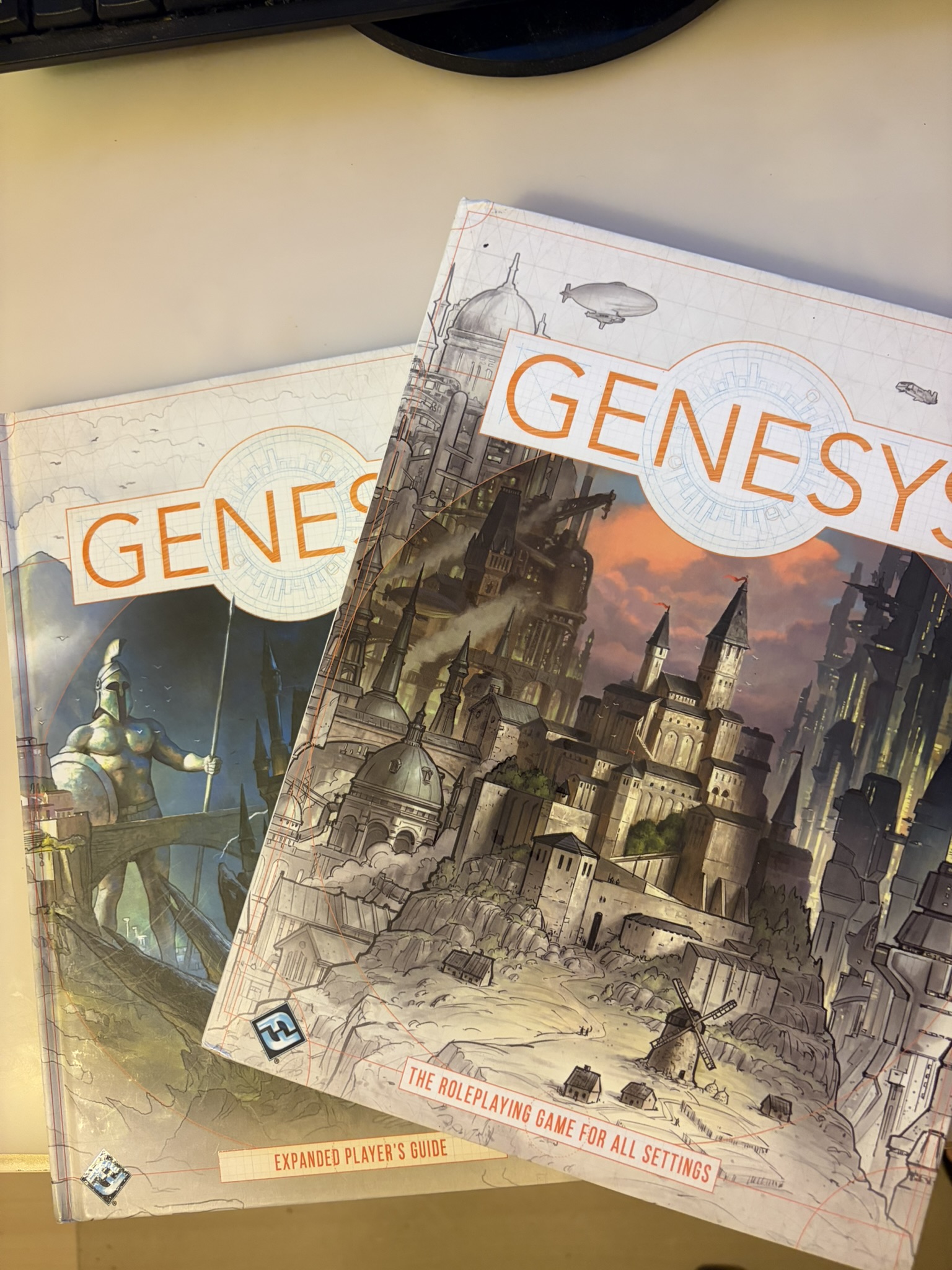
    Look. I know what the Genesys book says on the back cover about itself. Genesys is a very odd duck because, for me at least, it’s a game that doesn’t quite know what it wants to be. When it was just the system for Star Wars (actually, the Narrative Dice System specifically) it kind of knew what it wanted to be. It was a pulpy, swashbuckling system that let you do Star Wars-y things and have heroes that were nigh invulnerable or at least, hard to hurt.

    As a generic game, that’s fine too, but the NDS means that there are things that I THOUGHT would happen, thanks to the Narrative in the name of NDS, but it turned out to not be quite as narrative as I thought, and so the game ended up somewhere in between a nifty narrative game and a more traditional TTRPG. Which I’m sure fits some folks just fine, but I feel like the dice means it could lean more into the Narrative thing and it just doesn’t.

    Narrative, oh Narrative, Wherefor Art Thou?

    What I mean here is that the dice system for Genesys, with its several axes of outcomes and different ways of adding, upgrading and subtracting dice, could really be a mean, lean, narrative machine. This will sound weird, but the way the dice work (and have worked at my own table) can make each roll as “powerful” as a roll in Burning Wheel.

    In BW, each roll is something you weigh in on from all sides; you gather your base dice, check to see if any of your OTHER skills can add to it, get Help from the other players, argue for advantages and what not, and then roll the dice. A roll can be a rather involved thing.

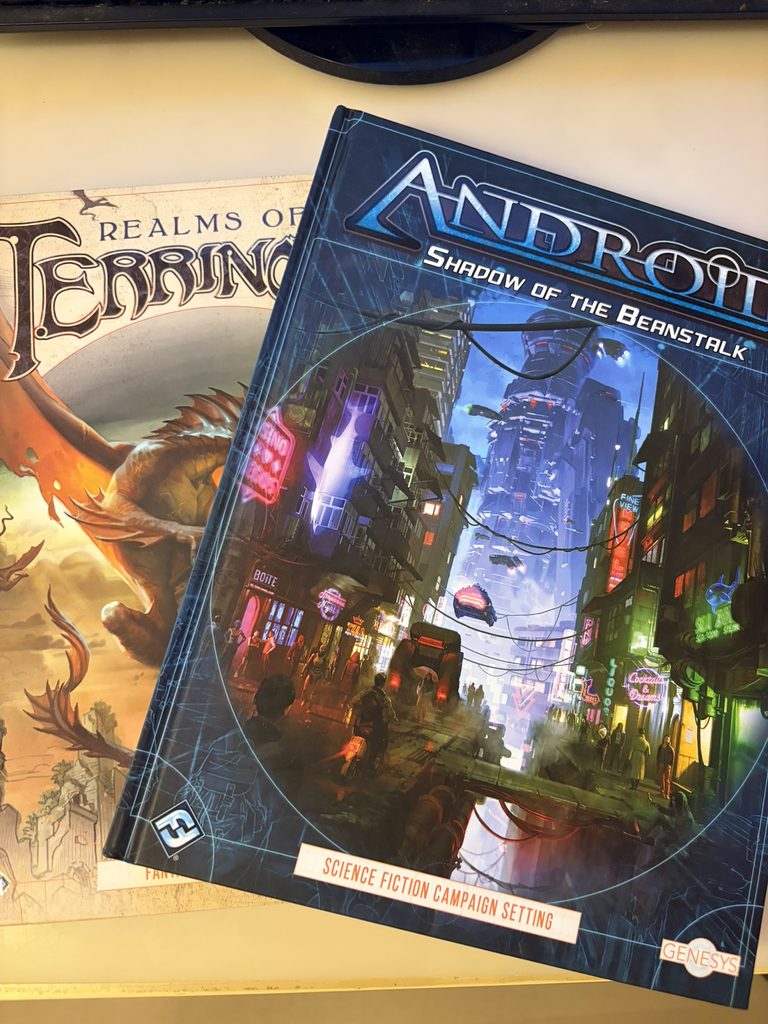
    Genesys rolls can end up just as involved. Gather your base, add in Boost or Setbacks as you and the GM wish, figure out Story Point spends, see if anyone is helping you, and then roll the dice. Because we get so much information from a dice roll, they can really do some heavy scene lifting. For example, for the Shadow of the Beanstalk game I ran (based on Edge’s cyberpunk setting Android) I created a skill called Contacts, where players could roll up who they knew if we needed an NPC on the fly (like Burning Wheel’s Circles ability or the Contacts skill in Fate, which I cribbed it from in the first place). The information-rich die roll meant I could determine if the PCs found who they wanted, but then, because of Threats or Despairs, we could say your friendly contact came with a whole bunch of bad things around them (maybe they tipped off the enemy about the deal, maybe they brought you faulty goods, whatever). The dice really helped drive the narrative, giving us interesting story twists.

    And Then We Got in a Fight

    Now, I want to say off the bat, my players were fine with combat and they had fun with it. That said, I, the GM, found it annoying, in that there was no “quick battle” solution. Take Savage Worlds; they have a Quick Encounter mechanic which basically lets you run an entire combat scene with a die roll or two from each player and some narration, then move on. Burning Wheel has such a mechanic, as does Fate; in fact, in those two games, you can run an entire “combat” with one die roll. Not so in Genesys (though I cribbed something myself for this, but it never felt terribly satisfying). That’s a crying shame since the NDS really cries out for the ability to do just that (on a side note, someone out on the Big Purple said that there is a system I’m looking for tucked away in one of the Star Wars supplements, but for some reason it didn’t make it into Genesys or the Player’s Guide).

    In Genesys, combat is pretty much as it is in a lot of games: multiple die rolls, checking things like range, cover, movement and so on, and many rolls later getting some results after whittling down Wounds or getting some Critical Hits than lead to a defining result. Again, it was fun! But not in as narrative a direction as I sometimes need.

    This is the same with the Talent list. The Talents are quite comprehensive, but, lean towards combat and the occasional bit of social-fu (since there is a social conflict system; highly appreciated!). I feel like, with the game calling itself generic, it needs other sorts of Talents. More societal ones, like social class or wealth levels. A lot of generics have this (even Savage Worlds, which is also a pulpy game, but it has Edges for these sorts of things, and other background things like being famous, and on the Hinderances side, things like having enemies hunting you or being an outsider or whatever). These sorts of things add mightily to a game, I think, since it fills in details about a character that make it easier to engage them during a session. This leads to my biggest “narrative let down” in Genesys: character Motivations.
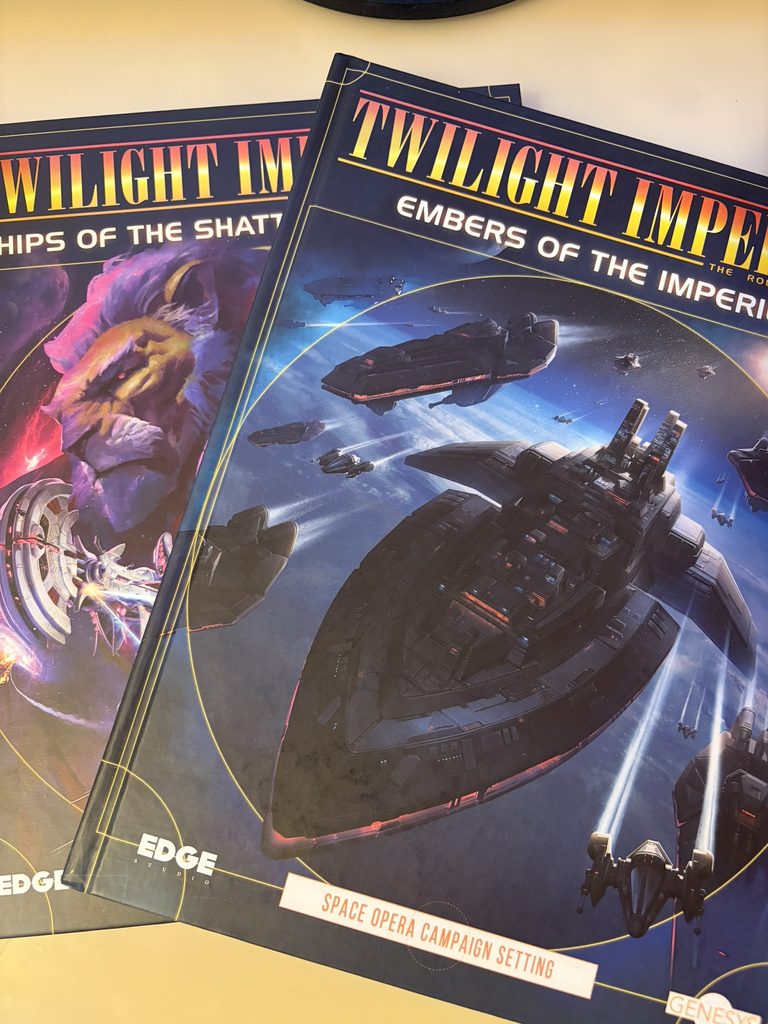
    Not Terribly Motivating

    You see, Motivations are supposed to be this thing in Genesys where you get a bit of a roleplaying aid, like, does your character Desire Knowledge or have Greed as a Flaw. That’s all well and good, but other than as a description and something for you to roleplay, they don’t really do much mechanically.

    For me, this is a missed opportunity. In plenty of games, we get a similar thing, but it lets you do something mechanically, which ties it back to being something that players will care about and act out. For example, in GURPS, many Disadvantages have self-control rolls that you have to make, or they kick in and make you do something you don’t want to. In Savage Worlds, Hinderances can, at a minimum, get you Bennies if you play them and the GM rewards you for roleplaying them. Even Mythras, a game not famous for its narrative leaning, has a Passions mechanic, which lets you have different things your character is passionate about that might affect his or her rolls in a situation that fits the passion (Loyal to the Queen? You can get a bonus to fend off her assassin or protect her personal interests in a negotiation). Heck, you can even roll the Passion itself to guide what you do (feel Passionate about your family? What if you can get very rich by selling out your brother? If you don’t know which way to go, or are conflicted, you can roll the dice and see where your character leans).

    In Genesys, the only real mechanical heft for Motivations is in the social conflict system, where if a player or NPC knows another character’s Desire or Flaw, for example, they can get a Boost die or something on a roll to influence you. But you can’t use them to benefit your character, and the GM can’t use them to get in your way (though I know some GMs houserule this way).

    I Didn’t Really Mention the Dice
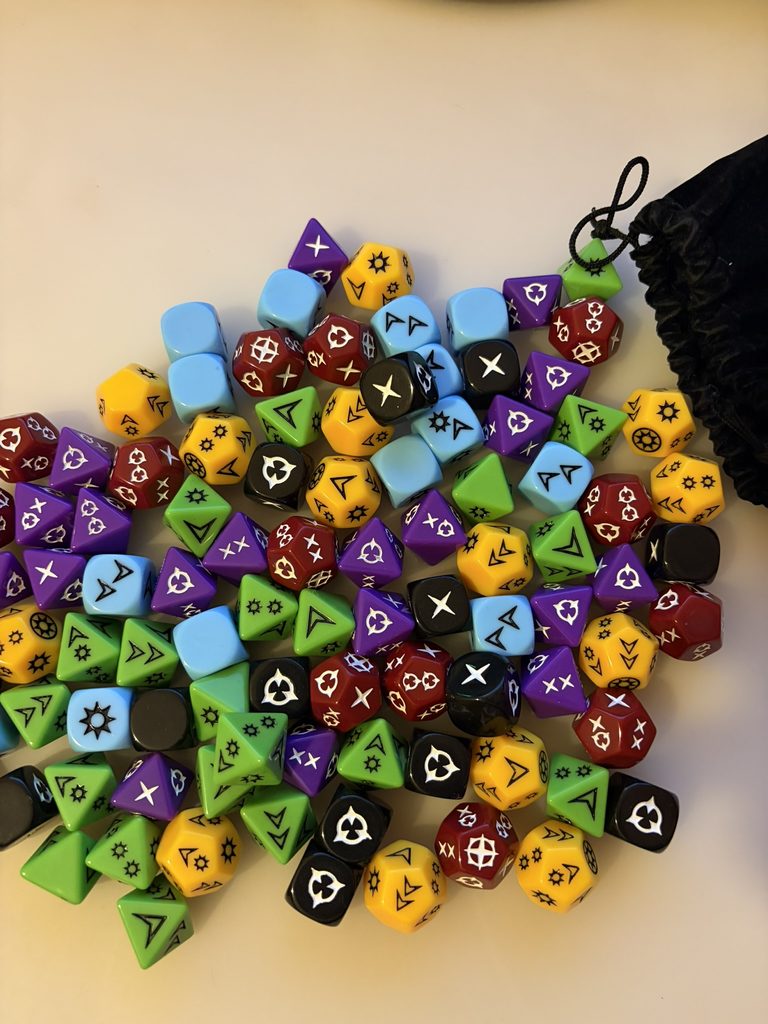
    Ahem…I MAY have a problem.

    As said, there are a pile of reviews out there, talking about the dice and how they work in detail. You can find a plethora of reviews about Star Wars, and then Genesys. LOTS of die-math out there too. All I’ll really say is that the dice are fun, and I’m glad I bought a bunch of them to use at the table. The various groups I’ve introduced Genesys to all picked up the dice reading pretty quickly, within that introductory session usually, and away we went.

    In terms of GMing, they were a nice crutch, though I did my usual GM thing, and said “Tell me what happened!” whenever players rolled and I didn’t have something specific in mind. Again, people enjoyed that too. So they were a hit, at least, whatever else people say about the dice.

    My Verdict?

    I know I sound like a sourpuss above, and griped and griped and griped. I gripe because, in general, I like this game; there’s in fact a lot to love even.  My players and I have had fun every time I’ve run the thing for various groups. No one’s ever told me they hate it or didn’t want to play it anymore, so that’s a plus (for example, I’ve had plenty of people bounce off Burning Wheel, hard; I’ve lost players over that game).

    So, go play it! That said, if you thought the Narrative Dice System was strongly narrative, well, it isn’t, at least not the way I was hoping it would be. So keep that in mind. It’s a lot more traditional than I had imagined, though interestingly, it made a nice “bridge” between more traditional play, and when I later introduced one of my groups to Fate. They were hardcore D&Ders and Genesys turned out to be a good off ramp into more narrative focused play.

    As always, leave a comment if you found something interesting here!
  • My (Rather Long) Review of Mythras

    My (Rather Long) Review of Mythras

    This one is long (you’ve been warned):

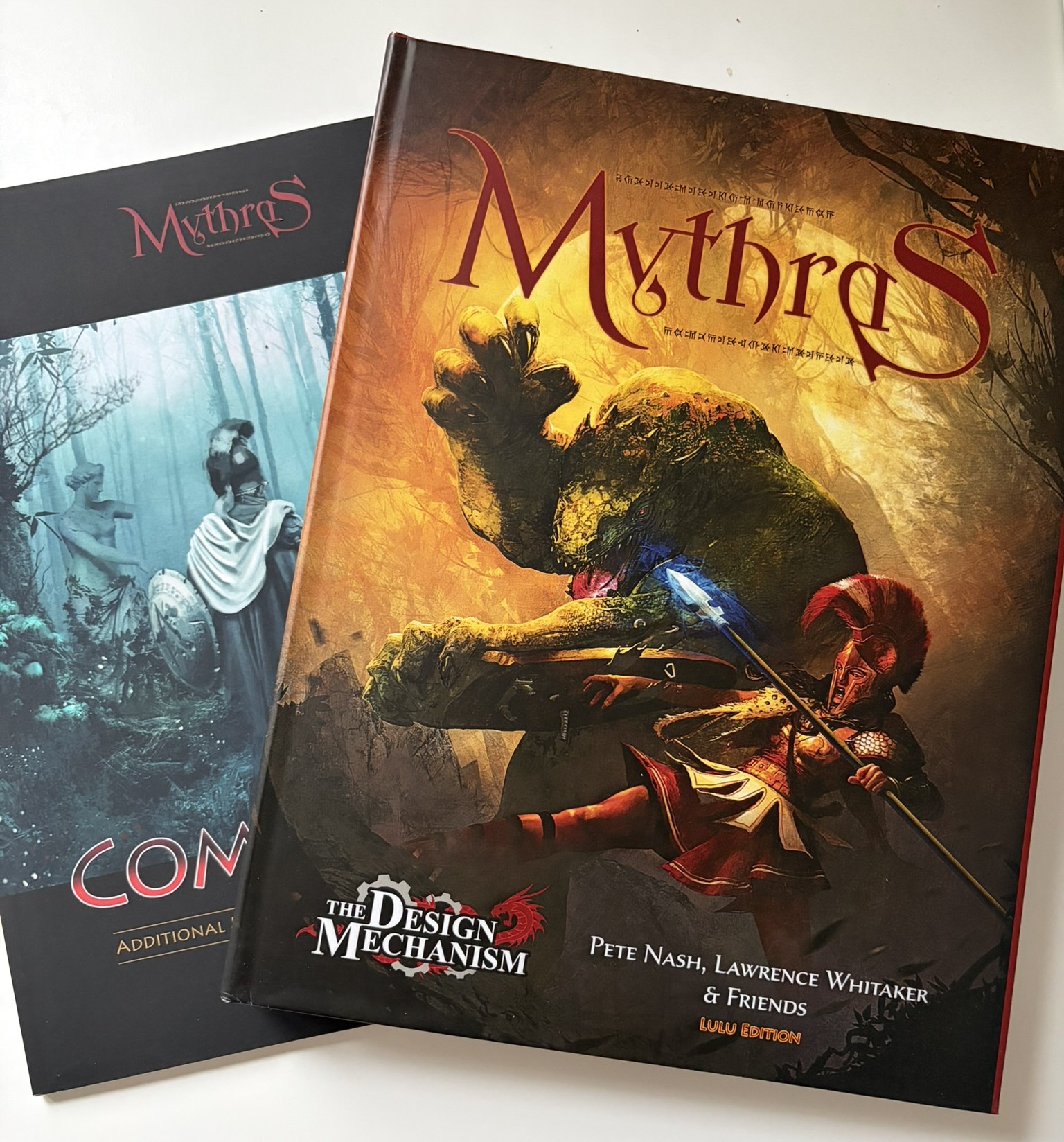
    Mythras is an interesting animal to review. On the one hand, it’s obviously derivative of Basic Roleplaying (and it’s first incarnation was called Runequest 6 even, so the DNA is obvious), so a lot of what I said I liked about BRP here holds true for Mythras as well (and indeed, that’s how I ended up running it in the first place). On the other hand, Mythras does some things quite differently than base BRP, and those differences make it interesting to examine.

    So, in this review, I don’t want to rehash the similarities between the games. For example, both use percentile, there’s an extensive skill list, both games lean more “realistic” in terms of, say, low or historical fantasy (my favorite genres so you can see my easy interest), and both handle advancement through Experience Rolls (though a bit differently, as I’ll get into below). I have a pretty long shelf of Mythras stuff, and it’s time I talked about it since the game figures heavily in my consciousness (and the gaming table).

    What is Mythras?

    Again, I don’t want to belabor the point, but Mythras is a direct outcropping of BRP. I’d personally go so far as to say that Mythras is an extensive rewrite and refocus of BRP, except it was made by two people who were not part of Chaosium, and were approaching things from their own needs and wants in a game system. And it incorporated things from other games the writers had been involved with, so, I take it back. Mythras is a game that has its roots in BRP, but the foundation has moved a bit, though still contains many of the strengths of that system, and has added its own to boot.

    The two creators of the company that publishes Mythras, Lawrence Whitaker and Pete Nash of the Design Mechanism, did work on various d100 based games, including the old Runequest II line from Mongoose). They published Runequest 6th back in 2012, based on their design ideas from the Mongoose work they did (and another game published around them by them, called Legend). That game, once Moon Design Publications took control of Chaoisum (the holder of the Runequest IP) was set adrift in a sense, so the Design Mechanism rebrand it as Mythras.

    What is Mythras Focused On?

    This is my opinion, so, I’m sure the authors themselves have said more on this, but for me, Mythras is focused on the historical and fantasy genres. The system has since then been stretched to do a lot of other things (from Science Fiction to Supers) but I still think the main focus is that historical-ness. In fact, many of their supplements (and there’s quite a library of them) are focused on taking a historical setting and adding magic and myth to it. Called the Mythic series, these tomes are usually pretty well researched, and give plenty of hooks and other ideas for any gaming table. I can confidently say, that picking up any of these books will give you enough history and other bits and bobs to easily run a campaign from it.

    With that out of the way, let’s talk about the differences Mythras has from “standard” BRP (or at least, what most versions seem to be). I’ll also mention where Mythras and BRP converge (there’s a lot of this).

    Special Effects

    This is the secret sauce that makes Mythras run, and as far as I’m concerned, one of the main reasons to run it. Basically, Special Effects happen when you make a skill roll in one of the conflict systems (so, combat in the core book, or social conflicts in the Mythras Companion), and you compare your roll to the opposition’s roll, and then see the final level of success. So, for example, if I roll a Critical Success to strike my enemy and they roll a simple Success to block me, then I’ve rolled a higher level of success and earned myself a Special Effect.

    What Special Effects you can choose depend on what conflict system you’re using (so combat Special Effects are not the same as, say, the Special Effects used in the Factions book or the Mass Combat system). What makes them so interesting is that, in combat, they solve an interesting problem, or rather, a problem of doing interesting things?

    What I mean is, in combat for example, let’s say you want to disarm your opponent; you have good narrative reasons to do so, but the two of you are in a fight. In general, for many games, you would declare your intention to disarm. The GM assigns a difficulty to doing so, you roll and hope you didn’t waste your turn if it fails. In other games, you might not be even able to do it unless you have the right Feat/Talent/Technique or whatever, and you’ll probably STILL be penalized for trying.

    Mythras’s Special Effects system changes this. Instead of declaring your intent to disarm and then rolling, you roll first (so you DO declare you want to attack them, anyway) and if your success is more successful than the opponent’s, you can look at the list and if you qualify (some Special Effects have requirements, like having rolled a Critical or even something specific like having attacked with a firearm) then you can choose Disarm. The opponent might get a reaction/resistance roll of some kind (Disarm triggers this, for example) but in general, you get what you choose. For example, if you succeed at your roll and pick Choose Location, you can “aim for the head” and that’s what will happen.

    This means that basically, for most rolls in combat (or any of the conflict systems) something interesting will happen. Because Mythras doesn’t really have Feats/Edges or anything, neither the player, nor GMs need to “build” what I can trick characters (for example, a character that is built around the idea of Stun/Locking people). Those builds can’t happen, and conversely, everyone has access to that sort of thing if they manage to get a level of success against their opponent. It also means the GM doesn’t need to adjudicate how various Talents or what have you interact with each other (a major headache avoided).

    The Special Effect system does one other special thing. In combat at least, you don’t have to fight to the death. There are Special Effects for disarming your opponent, or even getting them to Surrender.

    Of course, after signing it’s praises, Special Effects do have a problem – it’s going to take time for you and your players to learn. There are a LOT of them for combat. The other systems that use them (social conflict, mass combat and faction actions) have shorter lists, but still, things to read and learn, which take time and mental bandwidth.

    Character Creation Focuses on Community

    Remember back in my other article I said I like games that foster community (and BRP does), Mythras does too, but really dives into the idea. Character creation here is a step-by-step process, and each step is tied to some part of your life. For example, when you start picking skills, you first do so based on your background (say, born in a city or in a barbarian tribe), then you allocate skill points again in terms of your profession. Finally, you get some bonus skill points to represent what you’ve bene doing and what you’re good at. Which means you’re already tied more to the communities you are a part of, since we at least try to identify which ones shaped you as a person. At the end, all Mythras books let you roll for life events or some such that will give you extra story hooks and what not for the GM to play with.

    Skills are Arranged and Calculated Differently, Kinda

    So, Mythras is a percentile system just like standard BRP. One interesting difference though is that Mythras splits skills into two categories: Standard and Professional. I think the idea of Standard skills is quite clever – basically, these are skills that absolutely everyone has some skill with, things like speaking their native language, or understanding their native customs (it’s quite a long list, actually). Next to that are Professional skills, which are skills that require some kind of training or expertise to attempt (so, knowing about your own culture’s customs is a Standard skill since you grew up with them, but knowing them about other cultures is something you have to learn, and thus, a Professional skill.

    Also, the way Mythras handles calculating starting skills is interesting, and also has the added bonus of making Characteristics more important (and thus, creating a situation where there are no dump stats). In Mythras, all Standard skills, and any skills you choose as Professional skills, start at a rating usually equal to two of your statistics (so, they might be Strength and Dexterity, Intelligence and Charisma, or even Dexterity times 2 or something like that). I really like this, and wish BRP itself did something like this (there is an optional rule in BRP, adding a Skill Category Bonus based on your skills, which sort of like Mythras’s rule but not really since the bonuses aren’t usually that big (average of 0-3%).

    Experience Rolls are Different

    This is a slight difference but it does bear mentioning. In Mythras, at the end of a session, instead of looking at which skills you used in the session and rolling to see if each skill goes up, you gain a number of Experience Rolls given by the GM (modified slightly by your Charisma – the idea being, if people hate or like you more, you’ll have more interesting experiences, or people willing to nudge you along, I guess?). This is interesting because it means that you don’t only roll to increase skills you used during the session, but you can spend these Experience Rolls to increase any of your skills, or to even buy new skills. You can also use Experience Rolls to buy new spells if you’re a sorcerer or spell-casting priest, for example.

    Hit Locations are the Default Rules

    This is one of the few places I’m not in agreement with Mythras (though to be fair, several BRP games use this too). Hit locations of course refer to the fact that in combat, when rolling to hit and damage, that you’re actually hitting a particular part of the body (which will have it’s own armor rating depending) and you do damage to that part, and not the whole. What’s slightly different than some BRP variants of this is that there’s no “overall” hit points – in some BRP games, if you take, say, three points of damage to your arm, you ALSO take three points of damage to your overall HP. Mythras treats them separately, and you can only die instantly when you get a Wound that pushes you into negative territory, in your Chest, Abdomen or Head (and after failing an Endurance roll to resist). Interestingly, this makes characters a little tougher than in the BRP system I described above, because you COULD get hit in your limbs, which while it’s bad to have a Major Wound there, it won’t lead to quick death (only if, after some minutes, you bleed out).

    So, in a weird way, while I usually don’t like Hit Location systems in games, Mythras gets a pass since the system can lead to a character being quickly knocked out of a fight (by falling unconscious because of limb damage), but not necessarily being killed. In the games I’ve run of it, this means I’ve had players dive into a fight they shouldn’t, get badly hurt, but not killed for it, so they’re a little more likely to be brave and try something dangerous later. A small but noticeable behavior change.

    Cults, Yeah, but Brotherhoods, Mercenary Companies…

    In most of the editions of Runequest, especially those that centered on Glorantha, the original fantasy world of Runequest, characters could be members of a cult, and organization centered around a god/goddess and that allowed you to be part of a certain community of believers, and for people more devoted, to gain magic and other power as you raised your skills and showed even more devotion.

    Mythras took this idea a step further and allows everyone to belong to some sort of organization, not just magic users or priests. The GM or player could create a merchant’s guild, or a wizard’s hall, or whatever, assign it skills members should know at various levels and other benefits as you move through the ranks. I think this is a really great tie back into the community theme I love so well, and it means your character also has something to strive for other than wealth from adventuring or whatever.

    There’s More to Say But…

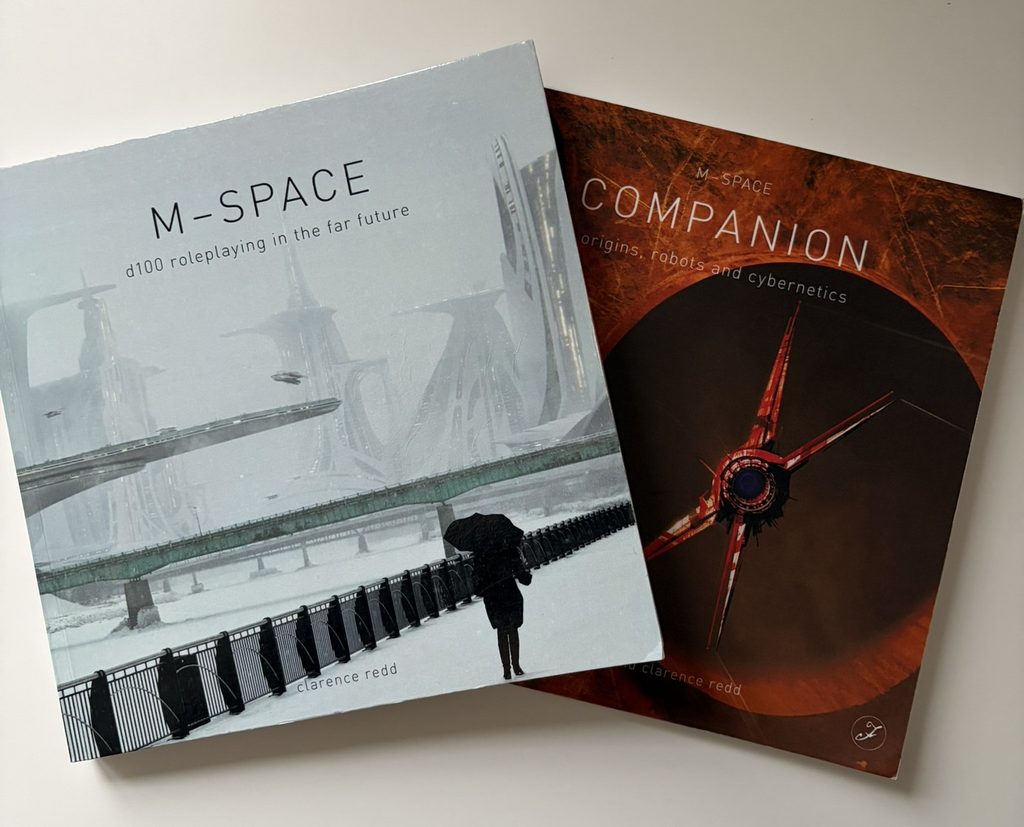
    As always, there’s a lot more to be said, because Mythras is a bit crunchier than BRP, so there’s lots of smaller, mechanical differences that also add up in making this game unique. Overall, I quite like it, and I really only have quibbles with two things: 1. The default of using Hit Locations (M-Space, a science fiction ruleset for Mythras, gives the option not to use them and have General HP instead, but otherwise, I’d have to refer to BRP for General HP, though since it’s a d100 game, its eminently doable) and 2. A mass combat system that isn’t QUITE what I want. Past that, I love it, and it enjoys rotation at my table every now and then.

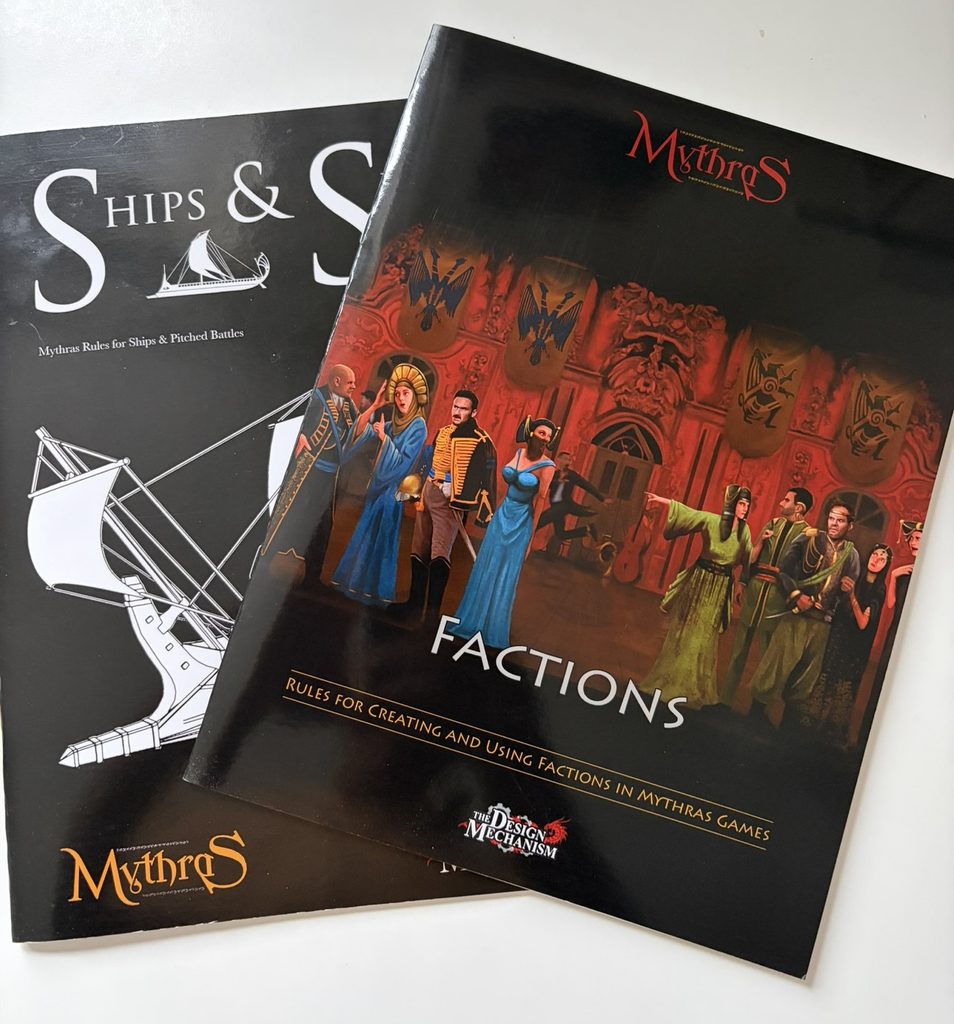
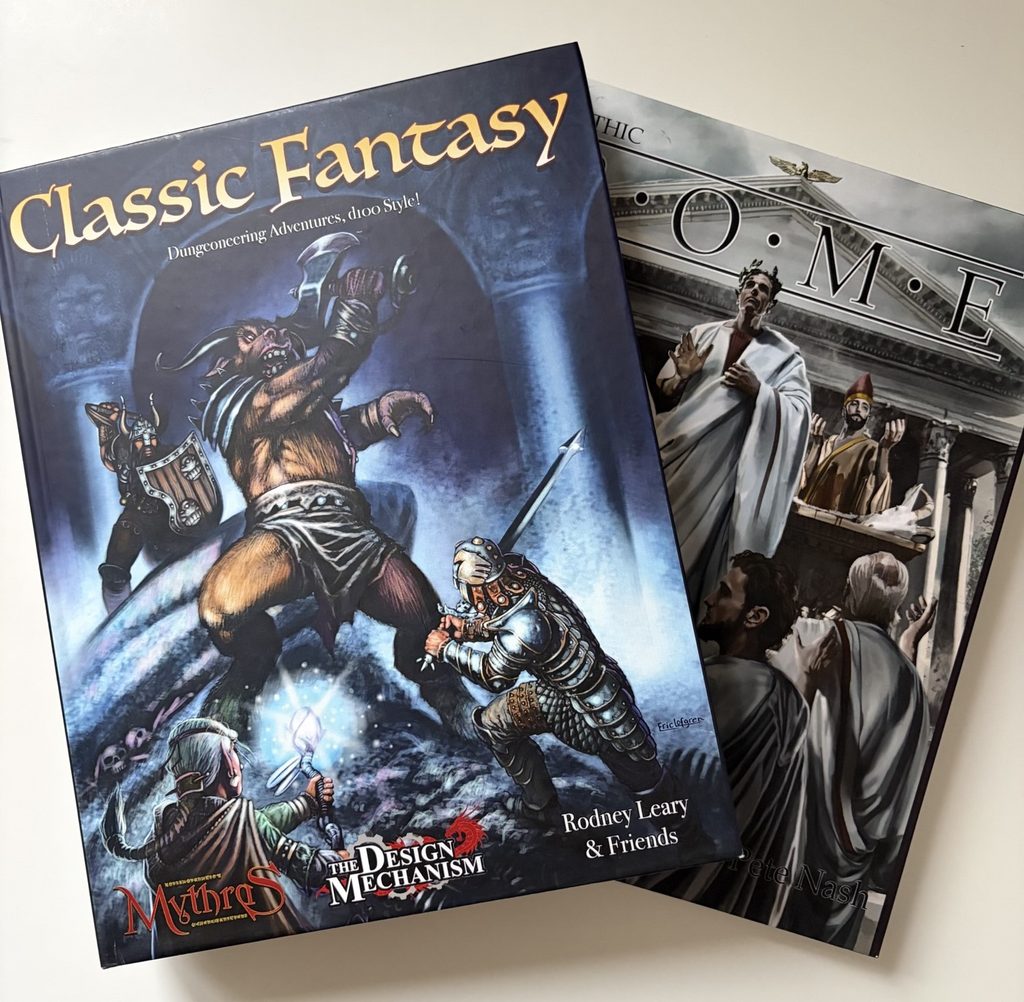
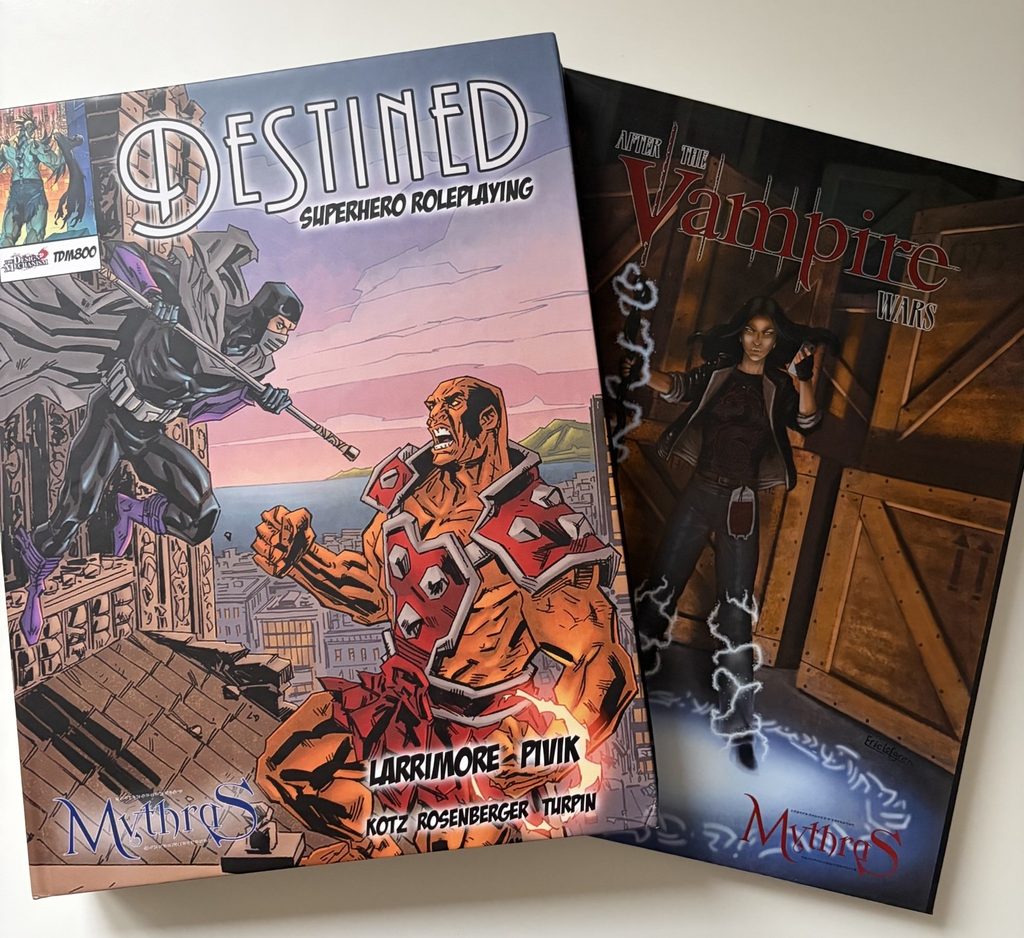
    Another advantage for Mythras is that, in the years since it came out, it has a large library of books, with my favorites being the rules supplements (like M-Space for science fiction and Destined for supers) and the Mythic Earth series (books showing a “mythic” versions of our own world, like Rome, Babylon, and a sort of Arthurian England (but more history, less knightly fantasy).

    Let’s not forget the ORC License! This is a license where, within certain limits, anyone can publish material for Mythras. BRP, I should note, is also part of this initiative. So this could be a good choice if you’re looking to publish something and your idea fits BRP or Mythras, for example.

  • Review of Basic Roleplaying

    Review of Basic Roleplaying

    In a lot of ways, this review will be more like the others I’ve done: I’ll focus on bits and pieces I think are important for my style, and the genres of RPG that I like, which I talked a bit about here.

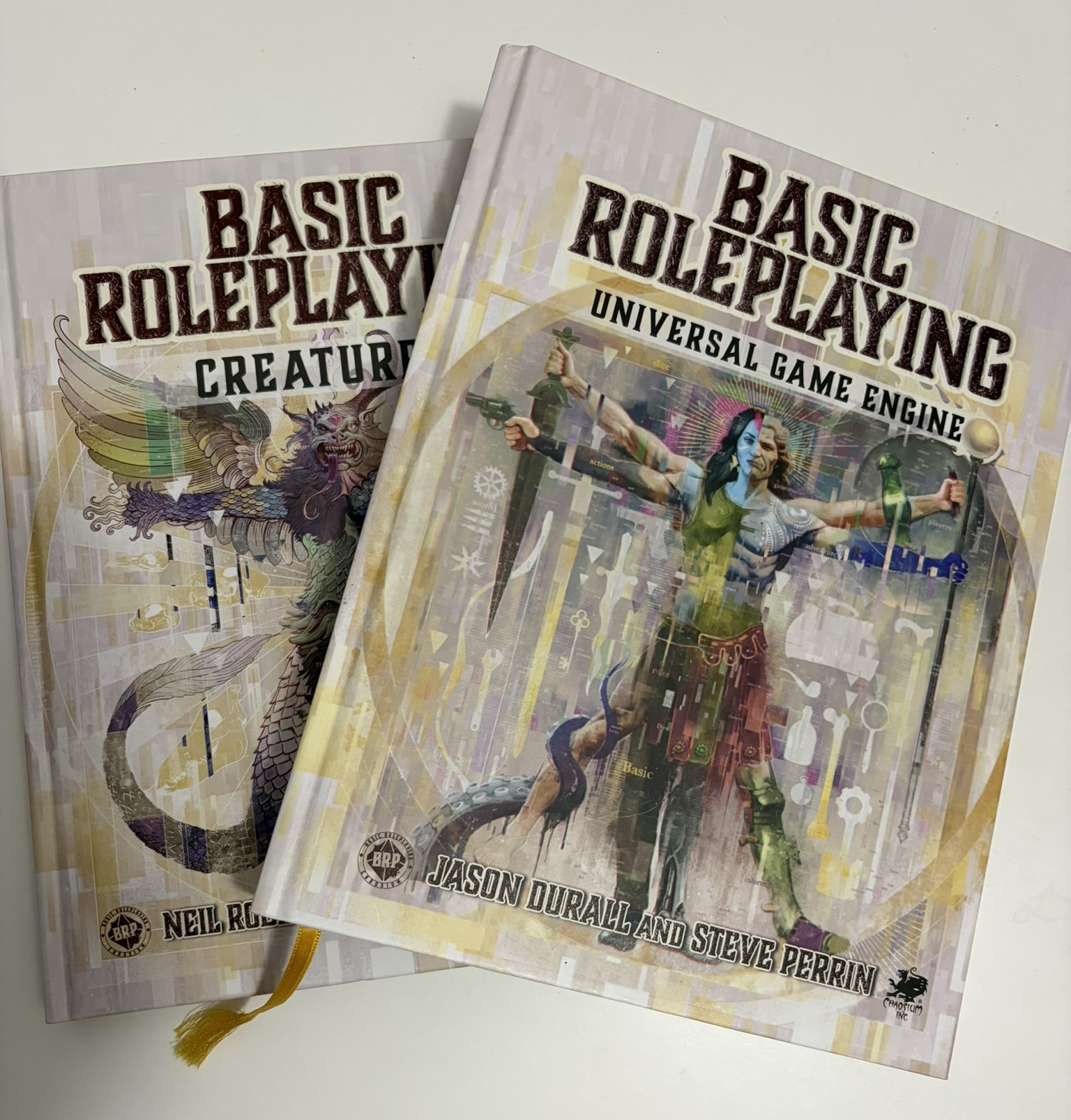
    Basic Roleplaying is one of the venerable games of our hobby. It’s been around since the first Runequest game came out in 1978, and has iterated itself as a system through a wide variety of games, including the aforementioned Runequest, and Call of Cthulhu which many of you will know, into a lot of side games in its early heyday like Elfquest and Stormbringer (and the dear to my heart Nephilim).  Runequest was quite literally my second roleplaying game after a few editions of D&D (if I remember, I got RQ3, back in 1990, and it blew my mind after playing D&D for the first three years of my gaming career; after that came Traveller, but it’s entirely possible I have the order wrong so don’t quote me on that – suffice to say, I picked up both games somewhere in the same year).

    So I want to review it today, because it’s coming back in style (though never truly out of style) and its on my mind more and more as I look for a game that hits the sweet spot for me of enough rules to hang my hat on, but not so many I drown in the details (dragging my players along with me). As I’ve mentioned before, I’m very much a GURPS and Burning Wheel superfan, but even I want something different, that gives a different feel than those two games can.

    What is Basic Roleplaying

    As I stated above, BRP is an old game system. The basic roll (haha!) is percentile, so, you roll 2d10 (one die being the tens, another the ones) and look to get under your skill. There various levels of success and failure that can be generated by the dice, but basically, roll under your skill or other check, and you get what you want. Pretty simple, right?

    There’s a bunch of other things to it, since this IS a legacy system, so there are a lot of little things that have been there forever that aren’t, say, as unified as they might be under some more recent game designs (for example, dice for damage rolls are completely different dice than used for skills in terms of percentile vs. d8s or d6s or whatever). However, these things are so minor, I don’t think any gamer will feel bad about them. Anyway, it’s a chance to use your other dice, so that’s nice.

    Let’s Talk About Our Feelings

    Actually, let’s talk about mine. Particularly when I’m talking about the feel of a game. As I’ve said elsewhere here in the blog, I’m very much a System Matters guy; to me, a system and how the rules work (and even things like the character sheet) shift our thinking and gameplay in subtle ways. Naturally, we react to how games do things, what rewards we get from playing the games in certain ways, etc. It’s why I’m a big fan of generic games, but I also understand that by necessity, a generic game isn’t “bland”; it has its own “flavor”, and that flavor, uh, peppers everything in the game to its “taste.”

    For example, I’m a big fan of Savage Worlds. It’s a generic game, and it has some great, extremely useful sourcebooks for Fantasy, Science Fiction, and Supers. The sourcebooks are written in a way that you can use them to mimic any TV show, book or movie you’ve ever seen, or something that’ll work, mechanically, in whatever setting you want. However, SW IS a pulpy type adventure game; the mechanics point us in that direction (short, broad skill list, lots of abilities hidden within Edges, etc.). I’ve used SW for lots of things, but it is still a pulpy adventure game at the end. When I’ve tried (twice!) to use it for something Game-of-Thrones-esque, it fell flat each time, and I ended up switching to something else. Why? Because the game didn’t have the feel I was looking for, though the rules themselves worked fine and were, on their own, quite fun.

    BRP, then, has its own feel, despite its generic nature. It’s been used in a LOT of different settings over the decades of its existence, and has had two serious attempts at generic versions. Where it shines, for me at least, is in low-magic, more gritty types of games.

    How BRP Generates “Feel”

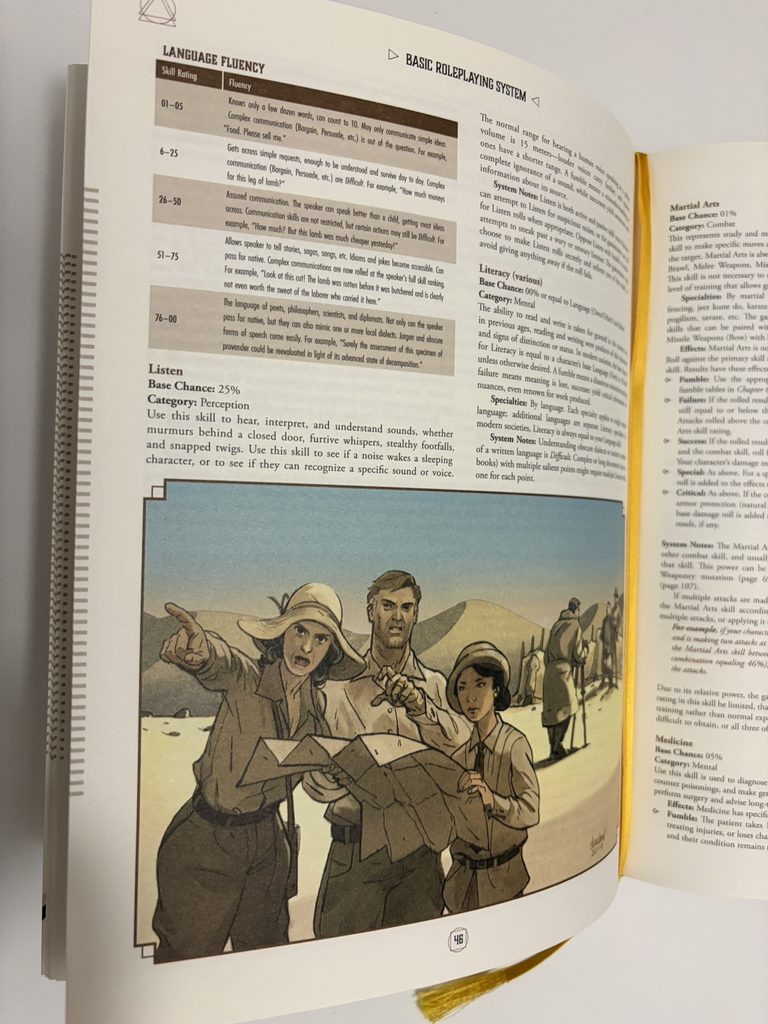
    First of all, BRP is BIG on having a lot of skills. Like, seriously, a lot. It’s even called a skills-based RPG by some (me included). The list has 58 skills, and some of those skills have subskills that you must choose to specialize (so, the Knowledge skill has more than 20 of them, for example). That’s something a lot of games shy away from. But this means BRP games want you to have differences between using an axe or a sword or a spear – and having the ability to fight with one doesn’t mean the ability to fight with another.

    BRP is also rather deadly, or at least, it’s easy to hurt PCs. Using the base system, a PC has maybe 10 hit points. A dagger does 1d4+2 points of damage; so, if you aren’t wearing armor, and you get hit twice, you’re down. Once you’re at minus HP, there’s only one way to survive – somebody heals you somehow enough to get to at least 1 HP (a successful Medicine or First Aid skill roll will do it, or magic or whatever is in your game world). So, combat tends to be fast and pretty brutal (most combats I’ve run in the system last 2-4 rounds, tops).

    Another way BRP gives its own feel to games is in what it doesn’t have – Feats, Edges or Talents are mostly not present (there may be some variant out there I don’t know or remember, but for most BRP games, your character has Characteristics, Skills and Equipment, and that’s pretty much it). Obviously, if you’re playing a fantasy game, you might have a magic system or two, or psychic powers in a psionic agents game, but otherwise, that lack of gegaws and other dodads makes characters, to me, feel more “real” (which is a silly thing since we’re talking about a game here). It also makes them easier to deal with. The closest we get to special stuff are the Superpower rules, because the main book at least uses those super powers to mimic things like an Elf’s nightvision.

    Easy to See Odds

    This one’s obvious, but I think for some players it can matter quite a bit. Basically, you easily understand your chance of doing something. If you have a skill of 30% in your Axe, then, that’s your chance of hitting each time you roll the dice. Some games make this opaque or hard to see on purpose (look at Cortex Prime’s VERY interesting obscuring of the odds math, which very much seems to be on purpose by the author’s admission) but I think it’s a plus to know your chances exactly. It also saves the GM a lot of work, frankly – you can definitely give penalties or bonuses, or say this roll is Hard because the character is partially blinded, but the skills are meant to be rolled in most situations at their unaltered level.

    Connection to Community

    Now, this isn’t necessarily done in all BRP based games, but a lot of them have the PCs as people connected to their communities in some way. Runequest: Roleplaying in Glorantha assumes that PCs are members of a tribe or city or some other community that you care about and are tied to. In Pendragon, you’re a knight with lands and a lord above you and all the social connections that entails. In the Basic Roleplaying: Universal Game Engine book there are rules for Passions and Allegiances (and Reputations), all of which are things connected to who YOU’RE connected to around you.

    This is a big deal for me. The rootless wanderer that does “missions” for well-heeled patrons is an old trope in gaming, and I know why it’s there. But for my own gaming, I prefer characters that are “grounded” somewhere. They belong, they are part of the furniture so to speak, and so, their actions and activities are rooted in that. I mean, trying to get rich is nice and all, but if it’s the ONLY motivation, for me, that gets stale, very, very fast. Even actual adventurers in our own world, who were definitely trying to get rich, had other motivations for what they did: to make a name for themselves, to move their family up in society, to create safety for their later life by making as much as they can now. All of those desires are rooted in being connected to a society that matters to you.

    Advancing Stuff

    Some nice folks online have reminded me of another key point I ought to bring up, since it’s quite different from the game we all start with, D&D (actually, it’s quite different than most games). In many BRP games, to Advance your stats or skills, there’s basically two options: one is training (which can be on your own or with a teacher). This is up to the GM to allow or provide, to work out costs for your character, but there is a system for it, either on your own as practice or with a teacher.

    The second is much more interesting and I think, as I’ll say elsewhere, gives BRP a big push into the “realism” section. In BRP, skills advance when you use them. That is, when you use a skill in the game you put a check next to it. Then, at the end of the session, you roll to see if you learned anything. This roll is percentile (duh), and needs to be higher than your skill. So, if you have a 60% in Underwater Basketweaving, and you use it this session, at the end of the session, you’ll roll against that, hoping to get higher that 60%. If you do, you increase the rating by +1d6% usually (or you can just take +3% if you don’t feel you’ll do better). This is interesting because advancement isn’t an all at once thing in various abilities, even ones you’ve never used (as with most level-using systems) or a matter of spending points to buy up something (as in MANY non-leveling systems). You only advance if you use it in the game (or pay someone to train you, as we discussed before). So if you want to get good at something, you’ve got to try it for real in the game.

    I don’t want to go into too much detail, but there are also ways to increase your characteristics, to learn new skills and spells and what not. And if you can’t do something through using it through experience (like a new skill) you can study (research) or, as mentioned, get a teacher or trainer.

    The Case for Basic Roleplaying

    Here, I’m talking in general. As I said before, there are plenty of games which use BRP as their engine (Runequest:RiG and Call of Cthulhu being the big ones, but there’s some smaller ones too like the game I’ll get in my hands soon, Age of Vikings). For me, BRP is a game I’d turn to if I have an idea that doesn’t really fit another game (though that works for any generic game), but more importantly, if I want the feel of a BRP game. As I’ve said elsewhere, I really like historical fantasy – BRP is perfect, since the gritty feel but generally easy rules are exactly what I’d want for that game. Honestly, every time I have a historical game in mind, it’s a toss up between GURPS, Burning Wheel and BRP. I think all of them approach gaming differently, and all bring unique things to a game. BRP isn’t perfect, certainly (a lot of the games I named above use Hit Locations, which I’m not fond of, though the base game makes that an optional rule) but it hits a nice sweet spot for me, letting me run what I want how I want, within the easy-to-grasp BRP framework. If it had a mass combat system it’d be even more in my rotation than it already is!

    Well, that’s the end of that. As always, any commentary, ideas, or things you think I missed, let me know in the comments!

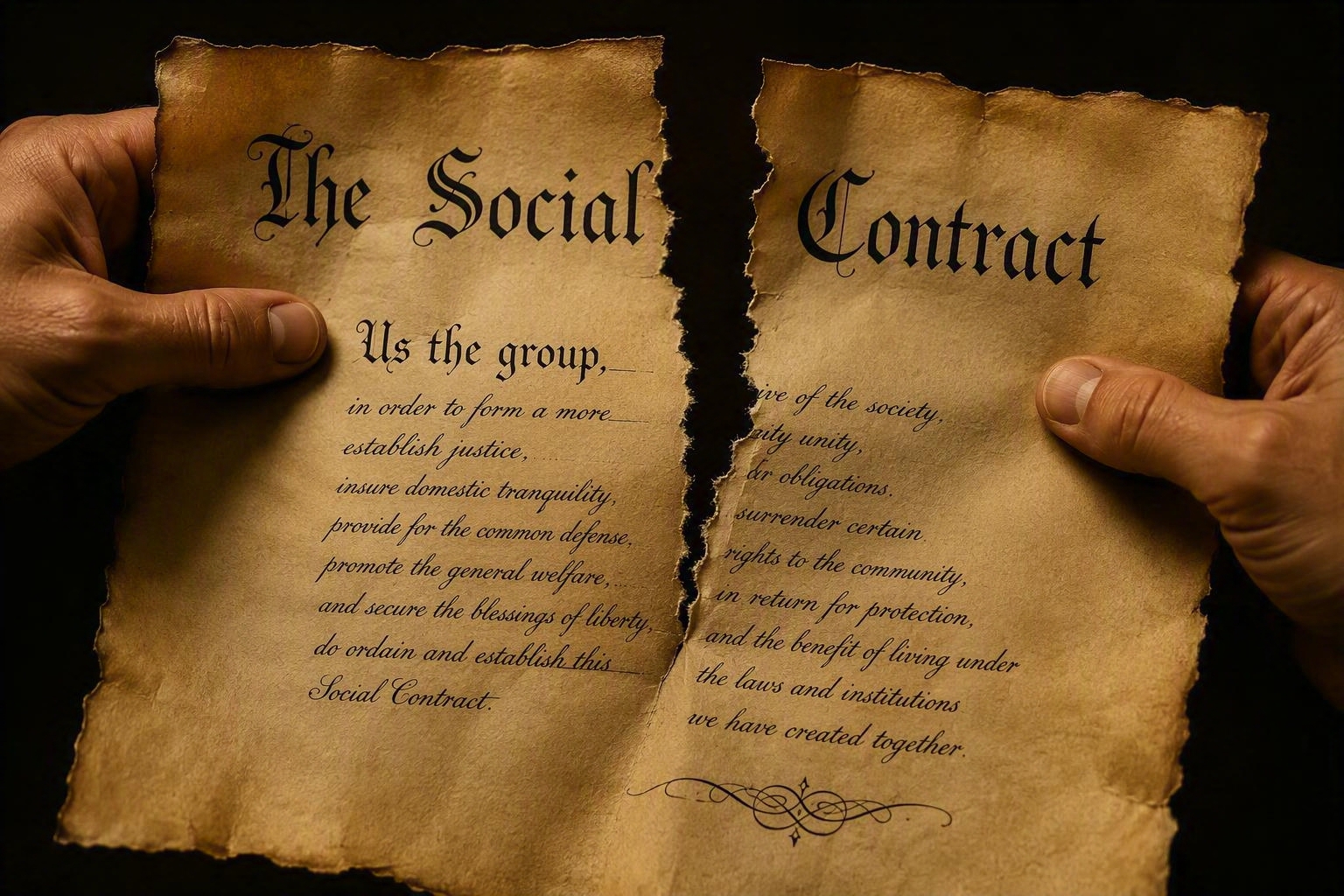
  • The GM gets to Start and Stop Whenever They Want, Social Contract be Damned!

    The GM gets to Start and Stop Whenever They Want, Social Contract be Damned!

    Questions connected this, or topics like it, abound on social media, especially Reddit. Many questions along the lines of “I’m tired of running X-game; what do I do?” or ” I want to change the ruleset, but my players will be upset; how do I tell them?” So today, I want to state it clearly, right from the start, then I’ll elucidate why: GMs get to start and stop whatever they want, whenever they want (and players then can choose to go along with it or not play with that GM).

    Pretty much that’s it. I’ll say more, but this is really the crux of the matter – the GM is a person, and as a person, gets to decide how they spend their free-time. There is a social contract in groups, yes; that social contract does not obligate me to run things I don’t like, for certain amounts of time, or to accommodate your particular flavor of game to the detriment of others.

    The Weird Gaming Social Contract

    Not to belabor the point, but the issues I see people complaining or asking about online seem to stem from some sort of odd, yet silently approved social contract a lot of us have about TTRPGs. Specifically, that one the game starts, it MUST GO ON FOREVER. As always, we can understand why – it’s an investment of time, energy, and even money, to get into a game, set up characters and maintain the stories we all enjoy. Who wants to invest that all again into something else (this of course leads to folks sticking to one game for years, and even a single campaign, even if the steam ran out long ago and they don’t enjoy it). I’d say that social contract is wrong, or at least, needs to be rewritten.

    GM = Workhorse


    Your average GM getting ready for this week’s campaign session.

    First of all, let’s all acknowledge it – the GM does the most work, hands down. There are very few games where all members of the group take on a lot of work to make the game run (in fact, the only one I can think of off the top of my head is Burning Wheel, mostly because most of the bookkeeping during the game is in the players’ hands, and everyone is asked opinions when awarding Fate and Persona points, or during the Trait Vote – these are all explicitly shared burdens, rather than just the province of the GM; but it still isn’t everything). Otherwise, it’s pretty much all on the GM. 

    For those that don’t know (though…who are you? Why?) GMs do a lot of work to make a game go, even in low prep games. For example, let’s take pre-game prep. At a minimum, GMs spend time imagining what the bad guy NPCs will do, their plans, their resources, etc. Many games require GMs to plan out the opposition for conflicts (mostly fights, but could be social conflicts too). We generally want out games to be a challenge, right? So the GM has to figure out opposition to the PCs that makes sense within the context of the game and the game’s math. Some games need even more planning, like writing up dungeons, or figuring out what Factions do behind the scenes in-between sessions, or other bookkeeping and menial tasks meant to set up the game properly. 

    During the game itself, GMs run the show – again, at a minimum, they frame scenes, sometimes get said scenes rolling, adjudicate actions between players and the game world, and generally ride herd on the game. They’re coming up with plot or story details (often on the fly), acting as the multitude of NPCs, and describing lots of things in detail verbally or by drawing maps and diagrams.

    GMs also often end up as the ones socially responsible, to some degree, about the fun others have. So, if there are personal player disputes outside of their characters (somebody feels another player is unfairly advantaged, or somebody thinks another player is disturbing the game somehow , the GM should take care of them, or any other issues (does a player want a character that doesn’t fit the game? Or somebody is harassing someone else as we play? It’s apparently the GM’s responsibility, to the point that some players will just sit passively as things happen they don’t like, and wait for the GM to signal what they should think or even feel about an at-table issue.

    I remember once I had a game with a guy that was racist – he had definite ideas about how minorities in the US should act, and took umbrage when a person at the table didn’t fit whatever was in his head, or didn’t like being assumed to do certain things (as an African-American, and another friend at the table being originally from Vietnam, we took exception to this). I confronted the guy at the table when he started on one of his racist things, and he ended up leaving the game right in the middle. After he was gone, and what shocked me, was that the other players got mad about it – why did I have to make a scene? I just should have told the GM afterwards, they thought. That feels so bizarre to me – I’m an adult, no? I can handle things, and voice if I have a problem (that others may think isn’t a problem anyway).

    So it’s a lot of work. For me at least, it’s quite rewarding work, but it IS work. I sometime feel tired after a game, and have even run my voice raw from talking so much.

    Why the GM Can Say No

    So, if I’m the GM and putting in many more hours of work into a game (as we well know many players only think about the game when they come to the table, and never again until the next session; in my experience it’s rare that players think about the game so much) than anyone else, then, I don’t see why I can’t decide where my effort will go. This isn’t job or a family commitment (and even then, people find ways to wiggle out of something they REALLY don’t want to do). No matter what, I get to decide what I do with my free time, and if I obviously don’t like something (like the game I’m running), I get to bail at a moment’s notice. Is it fair to the others? An excellent question. Communication is key. But as a GM, I reserve the right to change my mind right until we reach the table.

    Any Player Can Say No Too, By the Way

    This should go without saying but I sometimes feel folks need to be reminded: the GM is a player too. In some groups (and as some now expect) the GM is supposed to bow to whatever the players want (so, if a player wants to play a murder hobo in our Victorian romance game, we’re supposed to accommodate them somehow). But! The GM is also a player in the game, and should also get some things they want. I’m not saying a GM can’t compromise – we don’t want to have the GM control our characters or railroad us in a game that essentially boils down to the GM roleplays by themselves for four hours while we watch (I’ve actually had that happen to me as a player once; sort of the lead up to Forever GM-ing). So, in some groups, the GM is in a weirdly subservient role, meant to “facilitate” the players’ fun (while neglecting their own). That’s just wrong-headed. The GM is a player in the game; they have different tools and pieces, but in the end, they’re still also playing the game, and presumably get some sort of enjoyment from the experience. Or at least they should.

    This also means, of course, players can, and do, say no to playing something they’re not interested in. I know there are players that stay in a group for a game they’re not really feeling for lots of reasons: they just want to hang out, their friends are in the group, they think it’s the “only game in town”. I just think it bears saying that as a player, GMs don’t have to hang around. Yes, this game ends if the GM stops wanting to play (unless someone else picks up the mantle to run it), but they don’t have an obligation to be there, just like no one else does.

    GMs are Human (and thus, make mistakes)

    For my final point, I also want to remind people out there that, simply, GMs are people; they make mistakes. So, I take a long time to evaluate a system, and whether it’s right for a game I want to run. I ask question on forum, make a bunch of test characters to understand character generation. I sometimes even do a test run of the conflict systems. I listen to Actual Plays and read them as well. And yet, after all that, we can get a game to the table and it falls on its face in a way that makes me feel bad. Yes, of course, some of that may be unfamiliarity, but some of it is simply, this doesn’t work as I thought it would. As I mentioned elsewhere, I’ve often started a game in one system, and realized I needed more detail or some capability that this system doesn’t offer, but another does. I recently migrated a Viking England game from Fate to Burning Wheel, and after one session I already feel the game is better for it. Fate is a fine system, but BW fits better what I’m trying to do.

    Which is a long-winded way of saying, sometimes the GM choose wrongly. We play a session or three and we know, down in our bones, the game is wrong for us, or for the table, or for society at large. We realize we don’t have time to commit to this system, or maybe it just doesn’t work the way we’d imagined in our heads. And so we want to bow out or change it. Or maybe we’re just bored – we thought yet another campaign of Your-Always-Game would be fine, and then it turned out no, really, I can’t stand it anymore.

    So…GMs can Change Games? Or Even Drop Them?

    Yes. A GM can bow out and do something else. It’s your time GMs. Maybe you feel like compromising on a game, maybe not. Maybe this decision will push your players away. Maybe you’ll decide to give up GMing all together. It happens. But if you’re not having fun in a game, during your free time, why are you doing it? Don’t!

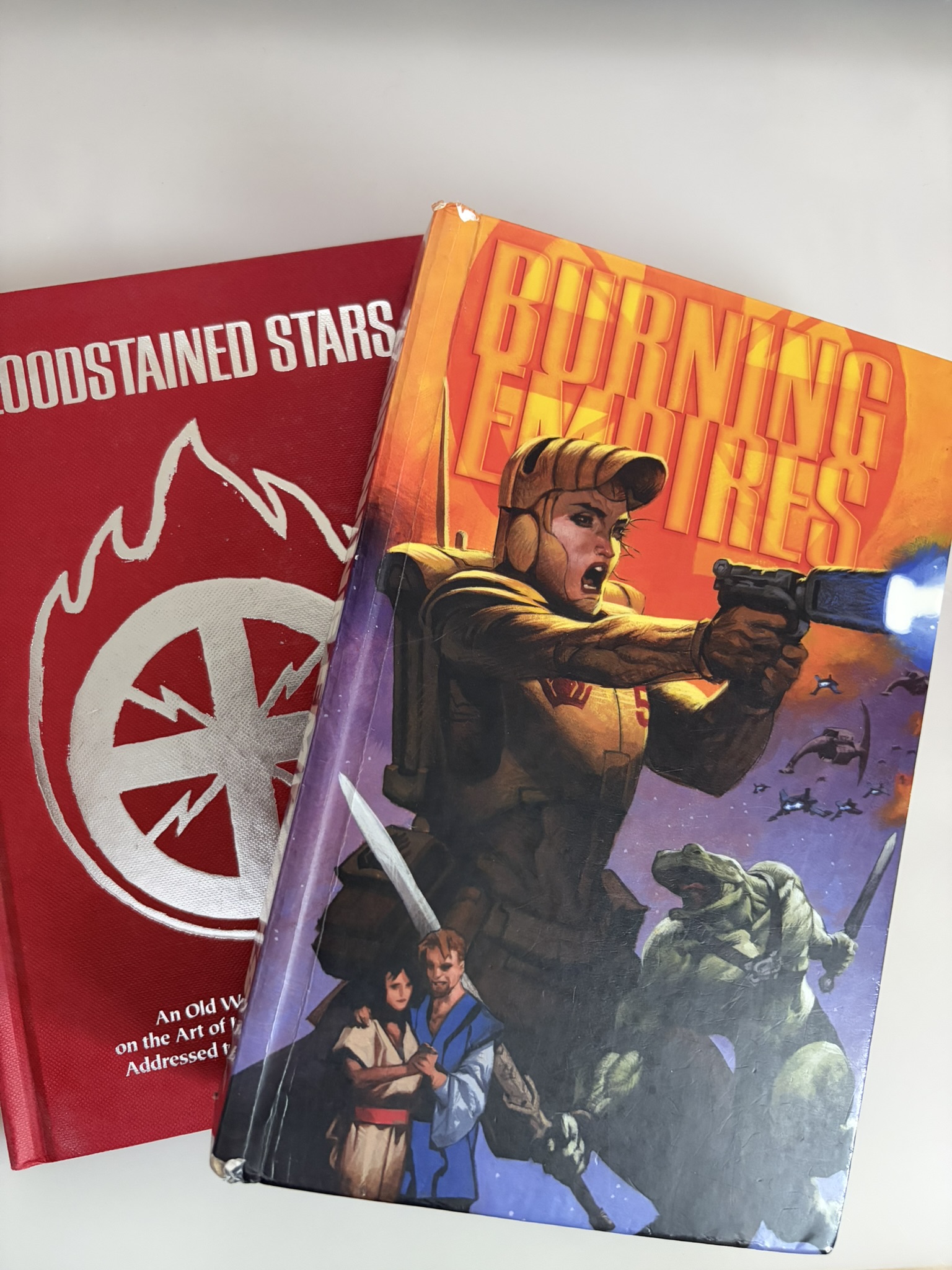
  • The Burning Empires Not Quite Review

    The Burning Empires Not Quite Review

    Burning Empires is the game that ironically got me to look at Burning Wheel more closely (I say ironically because I had owned BW, then SOLD it because it imploded my gaming group, then someone online gushed about BE – I bought it, fell for it, and re-bought BW, leading to my reawakening as a BW/BW/TB player). This game is also special to me because it made me really examine who I was as a GM, and what I wanted out of a game, and why I want it, etc. etc. I mean, GMs are players too, and have a certain experience in mind when they run a game, and things they want out of a game. This game made me zero in on what that is, and gave me ideas on how to examine it from time to time.

    So, like my Burning Wheel review, this won’t be a classic review where I go page by page and explain all the rules and all that. Again, there are reviews of BE online (and frankly, most of the rules in this book are exactly like BW’s, so you can read a BW review too to get an idea of how the basic rolling, Beliefs, Instincts and Traits, and other things work).

    What I want to talk about shortly (hah!) is what’s different. What makes BE not like BW, and what in this game pushed me, I think, to be a better GM all around.

    What is Burning Empires?

    First of all, for the uninitiated – BE is a science-fiction game based on the graphic novel by Christopher Moeller called the Iron Empires. In a nutshell, those stories, and this game, focus on the attacks of an alien parasite called the Vaylen, who seek to infect humanity so they can, in essence, bond with humans to live their best lives (the Vaylen can bond with other species, but humans are apparently “tastier” for the Vaylen, giving them a more vibrant living experience).

    The PCs are assumed to be leaders of humanity on a particular world, and the Vaylen are trying to get in and take over to use humanity as their vessels. The game works in phases, and in each phase, the PCs are supposed to do actions to hold back the tide against particular enemies who are, consciously or not, helping the Vaylen cause. There are a set of mechanics (called Infection) which act as a complex clock for counting down the action – the invasion is happening, so the question is, can you slow it down/stop it or not?

    This thinking, to me at least, seems to come from another BW game, a quite old supplement to Burning Wheel called Burning Sands Jihad. That supplement was Dune-with-the-numbers-scratched-off, and it’s premise was quite similar – in this case, you’re are members of the high command of a Noble world, fending off the Jihad of the newly created Emperor (in Dune terms, you are a noble family fighting for your world against Paul Atredies and his Jihad). It also had (an albeit simple) countdown mechanic was well, to track the success of the defense vs. the Jihad.

    What This Game Does Differently

    There’s actually quite a lot, and I’ve already touched on some of it above, but now I’ll go into more detail.

    You Build the Setting Together

    Between this game and Fate, I’ve including players in setting creation can yield great things. In BE, you actually have a set of lists of things to choose from for your planet, like Topography or Government type, which factions exist on the world, etc., which will determine the actual Lifepaths you can make characters from as well as the shape of the narrative.

    My first BE group, for example, created a world where the main industry was based around a healing chemical you could only find on this world, making it quite important. The government was a feudal one, but the local Church was a major player (and landowner) in the setting as well. They also decided the world was harsh and cruel, locked in perpetual winter, with everyone living in dome habitants on the surface, or space stations above. It was quite evocative that the High Admiral was his Eminence, the Baron of L3, Knight of the Holy Healers.

    Important from the Start, not Several Levels Later

    First, for me, the big change was framing the PCs as important, right from the beginning. These aren’t farmers on a backwater planet who are swept up into adventure, or newbie soldiers sent on their first mission. You start the game as a mover and shaker, someone important to the setting, who leads someone, somewhere. In my first BE game, one guy was the leader of the planet, another his High Admiral, and a third the leader of the planet’s mafia (the fourth guy I had to push up – he just wanted to play a nobody merchant for some reason; I pushed a bit, and got him to be the elected representative of the planetary merchant’s guild, but it took some pushing!).

    I’d already been running games this way in other systems, and some lend themselves to this (for example, in a recent Runequest game before I ran BE, one of the players became the chief of their clan; the other players were his Clan Ring). But Be is really one of the first that supposes you start that way. BW hinted that you could (it had lifepaths for military and court leaders and even royalty), but BE says “You’re it”. It even stresses that if you’re somehow not an actual leader, that you’re still a focus of the story and setting – your tribulations turn out to be pivotal to the Vaylen invasion one way or the other. I love this, and wish more games did it.

    Phases of Action (the Clock is Always Ticking)

    This is something I’ve tried to replicate elsewhere (for example, if I ever get around to trying to run the Pirates of Drinax again for Traveller, I DEFINITELY want something like this in the game). Shortly, there are three Phases of the Vaylen incursion (Infiltration, Usurpation, and Invasion). The following rules are called the Infection mechanics (meaning, do the Vaylen infect the world or not?).

    For each Phase (which takes 4-12 sessions, another innovation since the game has a loose endgame in mind from the start) you have a goal, something big that you want to change in the setting (for example, eliminating one of the planetary factions, deposing the currently ruler for another,  or changing the planet’s economic policy). You also have points called Disposition, which measure each sides’ closeness to being eliminated.

    In each Phase, you have a series of Maneuvers (usually 8-24 depending on how you play), which VERY loosely measures you moving towards whatever goal you stated for the Phase, but understanding that there might be lots of steps to get there. At the end of a Maneuver, you roll some sort of Maneuver action, to see what happened in terms of Disposition (for example, you could try to Assess the other side to understand them and their forces or machinations (important for other actions), and then later Pin them (you do something so the enemy can’t act as freely as they wish, effectively making them roll less dice for the next Maneuver roll).

    Now, all that’s fun and interesting and different. But now let’s dig into the REALLY innovative (to me) part: Scenes.

    Scenes as the Currency of Maneuvers

    This was the part that made me change how I GM for the better, and got me really thinking about what I was doing in game. At its base, the idea is that each player has a certain number of scenes they can initiate in each maneuver. These scenes are of different types (Conflict, Building Color) which I won’t get into, but basically, there are hardish limits to how many can be in a Maneuver. This does something interesting; it forces the players and GM to decide what’s important, what they must get done (the GM is bound by the same rules, by the way, since here the GM is sort of adversarial, in that they are playing the machinations of the Vaylen invasion). A player can’t lollygag around talking up every single NPC in the castle, because if they do that, they run out of Scenes, and then we roll the Maneuver and maybe they didn’t get anything done by then. To Help each other in rolls for the Maneuver, for example, PCs have to have Scenes with each other, so eventually everyone gets included and no one gets to be a loner loner-ing in the corner in a longer-ly way. Either they’re in, or they’re out of the action.

    For me, this was revelatory. In most games, we just sort of have scenes until the GM decides to stop chewing the scenery, or letting the players “click on each pixel” to get the maximum preparation and benefit from everything. There’s nothing wrong with this, mind, but the game really reinforces the whole “it’s an alien invasion on their timetable.” The clock is ticking, the Vaylen are coming. Each maneuver happens after a certain number of scenes, no matter what. The story moves forward.  What will you do?

    This made me focus as a GM. Each scene had to have meaning, even from my side. I noticed, when I ran BE, my NPCs were MUCH more aggressive. I did lots of “Lord Amber is calling for a meeting of the Council to demand an attack on [insert Players’ ally here].” In the past, I’d telescope it – PCs would hear whispers, they’d inevitably investigate, try to line up support, and on and on. They’d somehow maximize time in a way no human could (this is another issue to discuss in another post – why do we let players control their time so precisely, when in real life, we can’t even get them to come to sessions on time?). Everything took time. In BE, there is no time. If I want my NPCs to hinder the players, they’ve got to GET ON WITH IT.

    This has definitely bled over into my other games. I’m a lot more pushy and open about what I’m doing now. I get on with it. Ambushes happen right after other scenes. I know plan one or two THINGS to happen during travel; if I don’t have a plan, I just ask “Are you doing anything in particular? No? Then you arrive at the city after a 10 hour orbital flight” and move on. I work very hard to make scenes have meaning now (before, I’d sort of meander from thing to thing as we talked; BE made me stop indulging this behavior).

    This also connects to another principle I mentioned in my Burning Wheel review – radical transparency. Everyone should know what the heck is going on, and I include players in that. I tell them straight: “Based on what you hear in the King’s court, these guys are trying to get you kicked out; what do you want to do?” Again, in the past, I’d stretch that out, let them discover it – I do understand that is some of the point and fun for some players; they WANT to chew through the scenery and poke at every NPC until they feel they understand something very deeply. But that isn’t the way I run anymore. I’ve had players stop gaming with me because of it; I wasn’t into lengthy, florid, long descriptions and character studies and speculation anymore. I kept pushing (reasonably I hope, but yes, pushing) for people to get on with it. Commit. Make a decision. Act.

    Which I’m sure didn’t make me fun for some people, as said. BW does this to an extent as well, mind, but BE REALLY honed in on that conceit – there’s no time, get moving. In most of my game now, I also try to build lots of pressure cookers. Things have time limits before the enemy does something (and following radical transparency, I try to be pretty upfront about what that is and when its going down). I know some games do this with Fronts or something like it (Fate sort of does, for example) but BE opened my eyes to it.

    It also means I’m very clear that PCs be built to DO STUFF. Meaning, you’re not just making a character to play in the game, you’re making a person that’s going to meaningfully contribute to the story and setting and so on; they’re made so they’re a part of things, and so are going to act to protect/change/whatever the setting and people in it. Oddly, I’ve noticed in a lot of games, you just make a character – they’re there, and, yeah, that’s it. But even in games like Old School Essentials, I insist on it: who is this person? How do they fit? What’s their role in society? As a GM this helps me a lot, honestly, to give characters challenges, or at least engage the player a bit.

    The Adversarial GM (sort of)

    This flies in the face of most GM theory, but the game also has the GM act as a foil for the characters, and in the Maneuvers and Phases, you are, actually, trying to win. This means there are some rules you must follow as the GM (as mentioned above, for example, you also must conform to the scene economy of the game). You also must “burn” the main nemesis characters of the enemy side, and use their stats when you make their maneuver rolls and the like. No other game I know of does anything like this, where the GM is, actually, out to get the characters.

    There’s More!

    Except I won’t talk about it. Suffice to say, BE is chock full of good things and good practices. As mentioned above, BE has given me plenty of tools that I use elsewhere. It also taught me to be a better, more to the point and sharper GM. I think this has improved my games overall.

    Hope this gave some of you an idea of what Burning Empires is, and why it remains one of my favorite games, despite the fact that it isn’t even slightly generic in the way BW is (and usually, I gravitate towards generic or universal games anyway).

    As always, there are more articles that I’ve written, which you can have a look at here: Articles

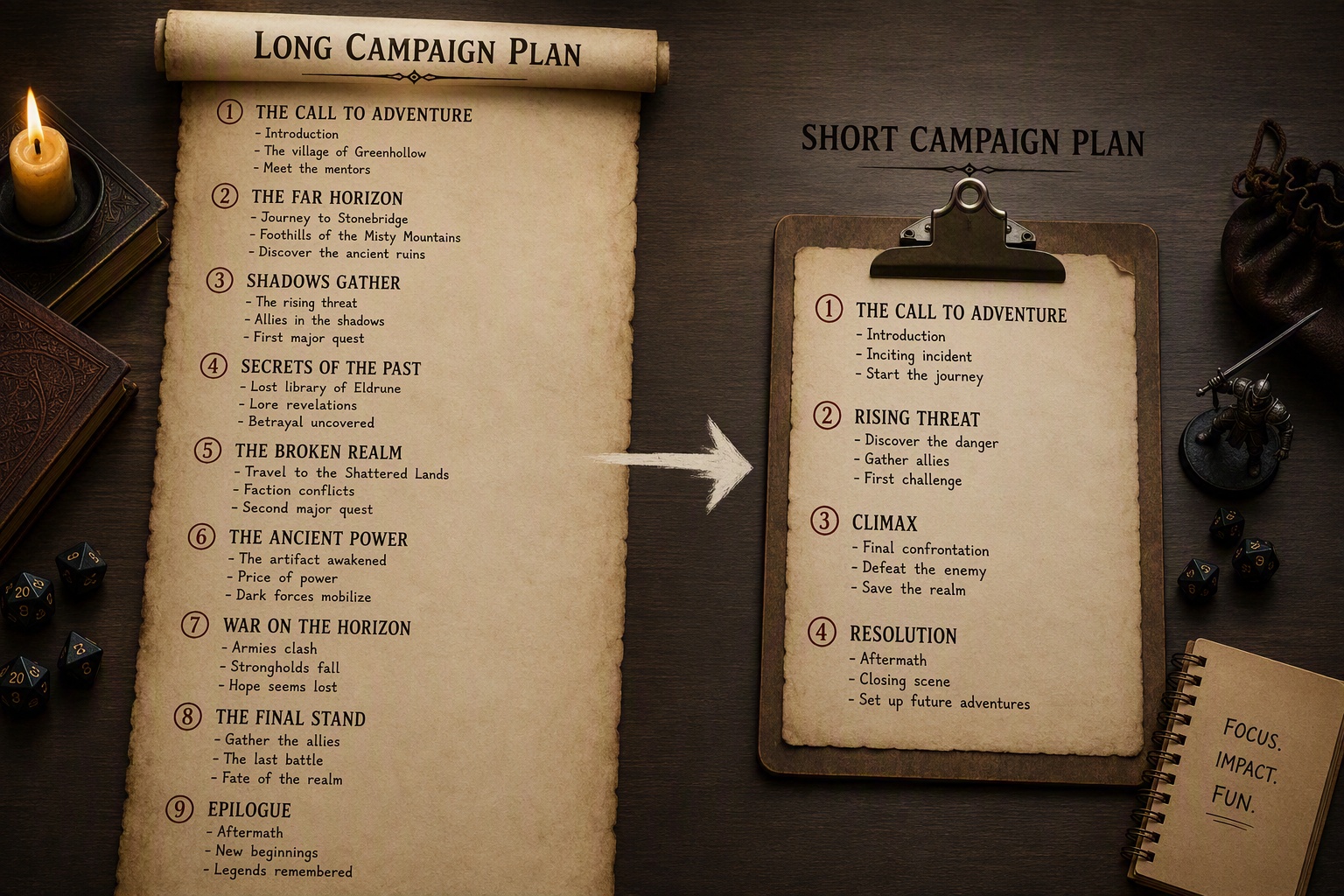
  • An Apologia for the Short Campaign and Why I Run Them

    An Apologia for the Short Campaign and Why I Run Them

    The Bog Standard Way

    It’s a truism in much of the tabletop RPG hobby that you basically pick a game and play it until everyone gets tired of it. We have plenty of stories of people playing one game (and one continuous campaign or setting) for a year or more (and the crazies who run multi-decade campaigns). It is also a truism that we should be playing once a week for 3-5 hours, so, these long campaigns have long legs indeed; upwards of 40 sessions a year and so on, for more than 120 hours.

    Lots of games lean into this model. The granddaddy, D&D in all its iterations, assume a “zero-to-hero” progression, which fits perfectly with the idea that you’re going to have 40-50 sessions a year, allowing a long line of progression from farm boy to hero of the kingdom. It wouldn’t be fun, after all, to promise lots of cool powers and abilities and never see them in something like a reasonable timeframe. Most Basic Roleplaying games (like Runequest or Call of Cthulhu) work this way as well – you might start out with a few skills in the 40s to 50 range, maybe one or two above that, and start playing. Usually, skills advanced (if you used them meaningfully in the session) at the rate of 1-4% or so (depending on your system; there’s some variance in d100 based systems) at the end of each session. So, at an average of 2% per advance, it would take at least 10 sessions to move a skill from 30% to 50%, for example, with the chance ratcheting down as the skill went up (since you have to roll ABOVE the percentage to advance in BRP games). This means you might only advance 1% each time if you were unlucky on the advancement roll.

    Burning Wheel is another game that works mostly with the premise that you’re going to play lots of sessions, for a long time. The advancement system really shines when you hit around the 20th session, when you really start to see some gains in the higher skills, and even a small chance of something like Artesia happening (it’s a big deal, trust me). I can add Traveller to the mix, but for a different reason – much of the game assumes long travel times between planets, and in many versions, and not terribly fast (or existent) skill advancement system. When the system DOES have advancement, it’s either absurdly short compared to the skills gained in character generation (weeks of game-time as opposed to years of game time in character generation to gain a skill level or two) or so long you won’t probably play enough game time to see it happen (one system gained you a new skill level or so every 2-4 years, though I don’t remember which Traveller system that happened in).

    This thinking also allows for people who play crunchier systems to have plenty of time to learn the game. If we go back to D&D, we have a game where the complexity of the rules ramps up over time as the characters gain more levels (and thus more Feats and powers); players are introduced piece by piece, and thus, have time to absorb the new rules (assuming they make any effort in that direction).

    The Case for Shorter Games

    Thing is…is it worth it? For many games extending into infinity, they peter out after a while, and never reach any sort of satisfactory conclusion. I know some groups do, and that’s fine, but I can’t imagine it’s a large percentage (the researcher in me would LOVE to know, though; it’s an interesting data point). I imagine the emotional payoff would be huge, assuming a “satisfying” conclusion happened. Video games like the original Mass Effect series are considered masterpieces (well, until the very last act of the third game) because there’s so much payoff happening once you hit that point: connections you made, characters you got on your side, alliances made and broken, actions having consequences far down the line. It is a great feeling to experience all that. But that happens because a professional TEAM of writers managed the story and pacing and all that (and I can’t say enough how mad I am about the ending).

    Now, here’s where I become Debby-downer. I don’t think a lot of us can pull that off. I’m no novelist or script-writer, and the PCs won’t do what I’d want them to do anyway, to make sure we reach that satisfying conclusion. How many GMs have created certain NPCs are our reoccurring main villain, only to have a PC one-shot them in a chance encounter? Or to glom onto a random NPC we made up on the spot that suddenly becomes the focus of their activities (I’m reminded once of a Star Wars game a friend of mine ran; he had a rebel contact guy whose cover was a Speeder Bike salesman; he because our main font of wisdom, and eventually, we elevated him to governor or something on the planet we were trying to free). Those sort of things are often fun, but that doesn’t mean we as GMs (or even the whole group) can make that into a satisfying wrap-up after two years of NPCs and storylines colliding.

    Personally, that’s one of my fears in long games. Again, I’m no real storyteller or fiction writer or whatever; I have no idea if, after a two-year campaign, I could bring it to a satisfying end. Instead, because RPGs are game that involve rambunctious players, or fly off all over the place, or leave the game, or new people get added or whatever, that I’d eventually story myself into a weird corner I couldn’t story myself out of. Meaning, in effect, I’d feel the time was wasted. Granted, we had fun getting to that point, but not having a good end would kill some of that feeling.

    Secondly, and this is very personal, I don’t really want to run one thing for that long. I’ve got a million ideas in my head, and a shelf full of games I want to run at some point or at least try out. Hell, my weirdo gaming format (because of work and other responsibilities, I can only run games once a month for about 5 hours) makes keeping the kind of continuity expected in the “play till the end of time” paradigm quite difficult. I want to try stuff; playing once a month means I have to be judicious with what I choose to play.

    How and Wherefore?

    Where does that leave me? Short campaigns. In general, I run things that last 3-6 sessions. I very occasionally hit around 10; it’s rare. By that point, I’m chomping at the bit to do something else. In fact, there’s a good chance that, if the campaign didn’t grab me from the start, I’ve already intellectually moved on, and so my last session or two is already getting lackluster. So I keep things short and punchy – and I work hard to bring some sort of satisfying conclusion to a story arc. Not always possible as I’ll discuss below, but the goal. Which means 2-3 games a year.

    Is that fair to your players? A big question, and one I’ll write a whole blog post on, I swear! But shortly: I do feel so, and after almost 40 years of gaming, and more than 50 years of living, plus my various troubles and tribulations, I’m not willing to hold onto and run a game if I’m not feeling it, system or setting or story. My gaming time is limited; it’s my main hobby, but all those other things I mentioned make it so I can only enjoy it a certain amount. I won’t waste time sticking to something if I’m not getting out what I want; that high from a good game is what I’m chasing, after all, and why I game at all. Hell, that’s a whole other blog post (figuring out what we get out of all this) but there it is. It’s like any other entertainment – if you’re not getting what you want out of it, why stick around? If you’re not fulfilled in some way (or several ways) what are you doing there?

    The addendum to this of course is that as GM, for the vast majority of games, you’re doing the heavy-lifting. You do the most “homework” between sessions, you come up with plots (or situations, or Fronts, or what have you), and even if players help you with that stuff, you STILL have to make sure and adjudicate if those makes sense at all. In the session itself you do all that turned up to 11, plus run the NPCs and monsters, deal with intro-player issues (and often the table will turn to you to even bring up issues, even if they know it’s an issue and should be brought up, they’ll defer to your doing it). It can be a lot of work. So, as GM, I feel it’s up to me to decide under what circumstances I want to deal with it. Obviously, if the players don’t like it, they can talk about it, we can negotiate a little maybe, but in the end, if I’m not having fun, I won’t run it.

    What Does it All Mean?

    Now, that was long-winded, but it’s something I’ve been thinking about for years. The topic comes up often when I describe my gaming situation (once a month, as defined by the Consolidated Spousal Treaty of Having Fun) and folks telling me that’s no way to run, etc etc. Fact is, I’ve been running short campaigns pretty much since I started back in 1987; can’t say I didn’t have free time then, but I definitely got bored with one game after a long time, and at the minimum, switched settings every 10 sessions or so.

    I do hope that some of you will be nodding along and realize that this is me describing how you’ve been doing things for years, or thinking maybe that IS what you should have been doing all along. Like any social grouping, I know social pressure is a powerful motivator – some of you may be hesitating to end a game you KNOW isn’t what you want, and others of you may be feeling guilty for ending it, especially if your friends are protesting the end since they didn’t get to whatever thing they were planning for the character (I once had a player who had a Feat build outline for a D&D 3e character from levels 1-10; somewhere around 7th level he finally expected to get to “the good stuff” and was marking time till then).

    As always, there are more articles that I’ve written, which you can have a look at here: Articles

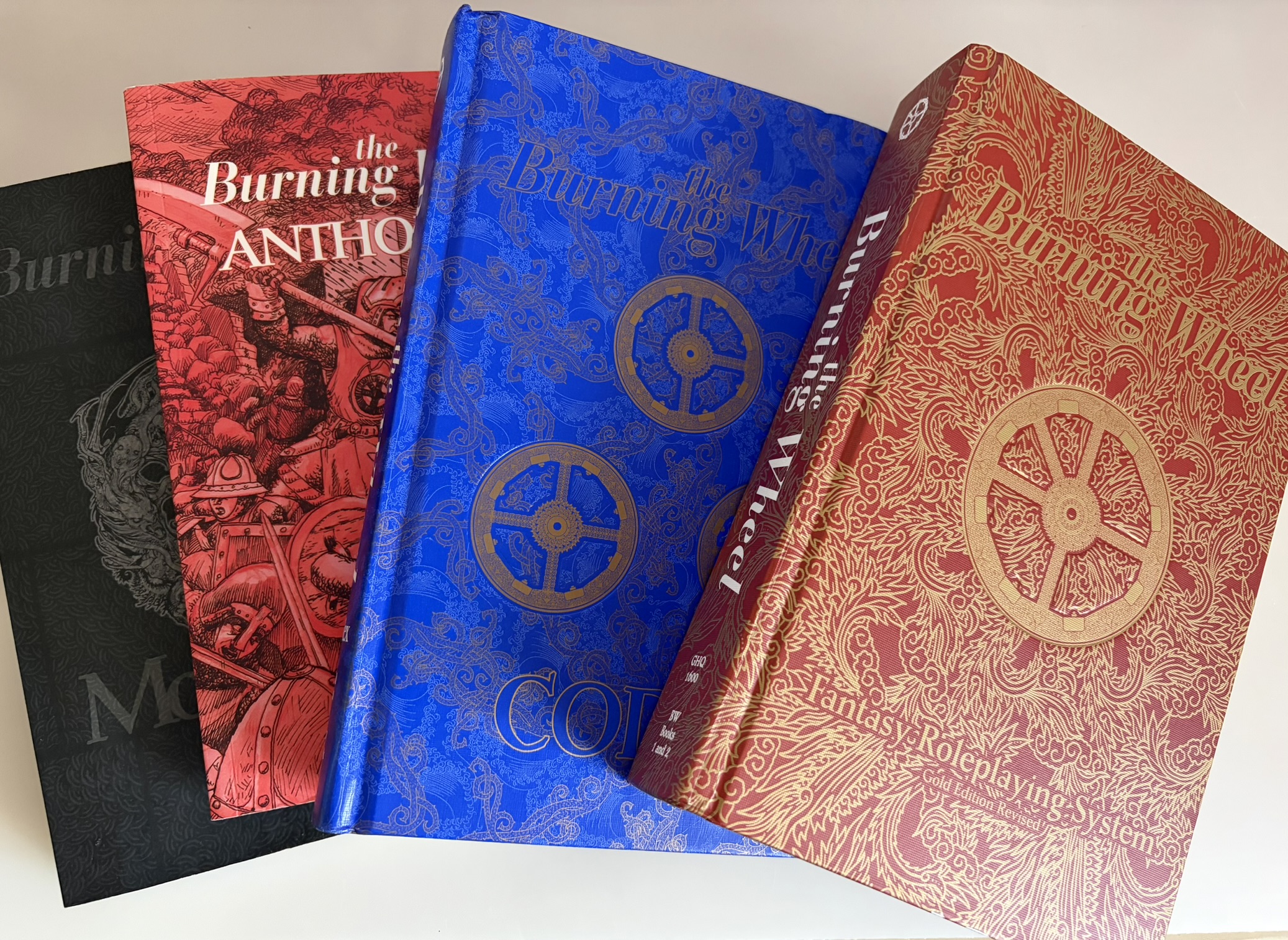
  • The Burning Wheel (Part Two)

    The Burning Wheel (Part Two)

    Here in the second part we’ll take a look at some of the other mechanics of Burning Wheel and why I like them. I’ll touch on the Resources and Circles attributes now, and Steel as well. We’ll then move into some general final thoughts on the game at the end.

    Resources

    A lot of RPGs work on the D&D model of money and wealth; you do adventures, you get monetary rewards, and you spend it. Now, there’s nothing wrong with this, and there’s even an element of fun to it since the player can indeed watch the number of gold pieces or credits or whatever go up, and can imagine gaining things for their character for it. For me though, it’s bean counting. I do enough of that at work, and I appreciate BW for NOT making me count money in-game. It’s also a great way to create even more tension and give players choices. Resources represent not just your cash, but favors owed, your place in society, and the willingness of others to give you credit and whatnot. It lets you buy and sell, do pure cash or whatever else you’d do with, well, your monetary resources. I think it’s a great system that lets wealthy characters feel wealthy, and incentivizes going out and getting paid (though the game’s activities). I strongly appreciate the Lifestyle rules as well, and wish more games had them; only a handful that I’ve played do, where the character needs to pay something to maintain their lifestyle and level of living (do you have an apartment? A car? If you’re a knight, do you have lands of your own? BW can account for all that.

    Resources is a weird animal in BW. It represents raw buying power, favors owed, your place in society, and the willingness of others to give you credit and whatnot. Roll the dice and see if you can purchase something. I personally love it, because it means I don’t have to bean count as the GM, and I don’t have to think about rewards so much (is 100 GP a lot? How about 1000? Is that enough for this job?). In BW, just look at the Resource level of the PCs, figure out how many expendable cash dice you wish to give them (or a permanent increase in Resources from, say, being ennobled) use the guidelines in the book and bang, your off to the races. I strongly appreciate the Lifestyle rules as well, and wish more games had them; only a handful that I’ve played do, where the character needs to pay something to maintain their lifestyle and level of living (do you have an apartment? A car? If you’re a knight, do you have lands of your own? BW can account for all that.

    Circles

    The greatest mechanic. I’ve made some version of this for many different games that didn’t already have something like it. To wit, Circles is basically what you roll when you want to find somebody. Need a captain to run the ship you just bought? Circles. Looking for a doctor in town willing to treat your ne’er-do-wells as you pass through? Circles. Because of how the mechanic works, it means the GM doesn’t have to rely on their own imagination for every NPC, and helps answer the constant question of – can I find such-and-such a person here?

    Steel

    Another favorite mechanic – basically, how psychologically tough are you in terms of frightening or surprising things? Can you stare down a dragon without running away? Can you keep control while hiding as your enemy runs your beloved servant through? I admit I don’t use this enough, but it adds something special to a game when used (much like Call of Cthulhu’s vaulted Insanity mechanics).

    All the Rest of It

    There’s so much more to talk about I could easily do a third or fourth article (and maybe one day I will). For example, we haven’t touched the scripted conflict systems, or how heath and damage work, or any of those things. Again, for a full review, there are plenty out there. But I do want to say that the whole injects elements of chaos to what the PCs do, and I personally think that’s good. In many games everyone knows exactly, mathematically precisely in fact, what they can do at any given moment: how far they can move, can they take on X-opponent, can they out argue the other side’s lawyer, etc. But in BW, these things are a bit murky. Weirdly, this gives the underdog a chance, and maybe that’s what I like the most. With work, smart play and effort, players can up their chances in BW.

    And I think that’s the end, really. Looking back, I’ve said a lot, and yet I’ve really said nothing, because there’s much more to say. I hope I intrigued you a little about this game; it is one of my favorites, and a game I’ll probably write more about later since I’m running it now for my group, and figures heavily in my thoughts. I also need to say something at some point about Burning Empires, an offshoot of BW, which has influenced me mightily as a GM, an Torchbearer, which intrigues me for a genre of play I actually don’t like very much.

    As always, there are more articles that I’ve written, which you can have a look at here: Articles

  • The Burning Wheel (Part One)

    The Burning Wheel (Part One)

    This article has been a long time coming, and frankly, is going to be a two-parter as I have a lot to say and plan to wax lyrical while doing so.

     You see, in a lot of ways, Burning Wheel is my “perfect” game; the author thinks about gaming things the way I do, and if I had any ambition to be a game designer, this is the game I’d want to have made. It does something weird which I think still isn’t done enough in TTRPG game design spaces: it says the game is character driven, and gives that part rules, but also make those rules crunchy, while tying them to several interconnected systems. I can’t think of any game that does this off the top of my head (the current incarnation of Savage Worlds sort of does, since it’s a pretty traditional game but has character focused elements sprinkled in like Interludes, or ways to turn the game from task-rolling to scene-rolling with its Dramatic Tasks and Quick Encounters – something I ought to write about later…).

    Anyway, this is one of the many things that makes BW sort of unique – it scratches my itch for crunchy games and also lets me have my character focused story-game as well, and makes it all work. It also does a bunch of other stuff that, for example, remind me of both GURPS and Fate as systems, but also does things in ways those two games don’t. If BW ever made a pure science fiction version (Burning Empires is great, but takes work to make it generic for other science fiction), I wouldn’t play anything else.

    So, I’m going to write about the game that I had a weird love/hate relationship, that has slowly turned to like and then respect as time has worn on. This is also a bit self-serving, as I’m running a BW game now (just started a few days ago) which has its own weird story since I’m switching to it from another system (from Fate, actually, as I’ve mentioned in my previous article about crunchy games).

    One more caveat – this isn’t going to be a review in the traditional sense. I’m not going to necessarily talk about what’s on each page and such not. More, I’m going to talk about why I keep falling back to this game, why I feel I have some of my best GM game ideas when thinking of them in BW terms, and why I keep comparing other games I play or run to it. This isn’t to say the game is perfect – it definitely isn’t, and has plenty of little things that have annoyed the various groups I’ve foisted this thing on and myself into selling the game away TWICE before finally turning to the light. So, it’s an odd beast, and one that has made me evolve (or was where I eventually wanted to be).

    Okay, but what is it?

    If you want a basic rundown, there are a whole bunch of reviews about BW in all its various editions. The latest is Burning Wheel Gold Revised (I almost expect the next iteration to be called BW Gold Revised Revised),. There are also a stable of games that have come after it, some not in print really (like Burning Empires, which made me absolutely a better GM, but more on that later) and some that definitely area and in their second editions even (Torchbearer and Mouse Guard). There are some other games BWHQ print (like Freemarket and the very new Interceptor), but frankly, I don’t know much about them and so can’t say anything intelligent thereof.

    So what is it? Burning Wheel is a fantasy game that does things in an odd way, because its take on fantasy is a bit off compared to quite a lot of other games. First off, it’s fantasy, but lends itself to low fantasy, but can scale up to an extent and, perhaps, capable of high magic fantasy. It can go as low as realism, and is one of a handful of games I’d recommend for a more historical approach to a game (the others being GURPS, Mythras and BRP). While it’s doing that, it’s also a character-driven arrow aimed at whatever the players decide is important.

    Beliefs, Instincts and Traits

    These three things (called BITs) are the arrow I’m talking about, and what has me gushing about this game, and more importantly, make my job as GM very easy. Beliefs are things that your character believes in, and will do something active about (so if it’s a Belief, it’s not just something you think or feel is true, it’s something you’re going to make sure happens in the world). Next to those, Instincts are things your character always does (because of what kind of person they are). Lastly are Traits, which are a lot of things that can help you do different actions, but are also ways to play your character.

    For example, imagine you have a knight with the Belief “The Church is in danger from the heathens; I’ll evict them from my Lord’s lands.” That tell us two things: 1. this knight thinks the Church is being overrun and; 2. he blames the heathens and is going to kick them out from his Lord’s lands because of it. For the GM, this means your job is to set up heathens doing heathen things for them to get mad about. But you can twist – maybe make an important persona heathen, so it’s not easy to get at him, or make a heathen sympathetic in some way, so evicting them hurts.

    An Instinct might be “Never say no to a fellow villager in need.” As a GM, this tell me to make sure the village is in danger sometimes, and that this player wants problems when trying to save people from his hometown. It’s also good because the character will generate Fate or Persona based on how they played up the trouble caused by the Instinct.

    Traits are the odd duck here. On one hand, a Trait might be as simple as “Lazy,” meaning your character (or at least people around him think) he’s lazy and unproductive. If you play that Trait in a way that gets them in trouble (say, handing the McGuffin to someone else to carry because you don’t want to, and they end up stealing it) then you generate Fate for the character. It also might do something dice (like adding to rolls) or even allow you to reroll dice or break ties. But even in those cases, it STILL acts as a thing you can play. For example, if your character is Gifted (which allows you to cast magic) it might also be that Gifted people are suspected of being dangerous to society, and so being known as Gifted can get you in trouble, too.

    These sorts of things (created by the player) give me plenty to do as a GM, and get players invested in what’s happening. Mind you, it takes a certain sort of player to get into it – the player has to be the sort that has some vague ideas at least of how they want to interact with the game’s situation, and what they might want from it for their character (which might me they have to take a bit of an authorial stance on the whole thing, thinking like a writer).

    Why That’s Interesting (Big wheel keep on turnin…)

    Now, none of this is unique to this game. Fate and to an extent Cortex Prime can ask the same thing of players. The difference for me lies in the execution – BW ties BITs into how you gain Fate and Persona points (which can be used to increase success chances amongst other things), which also ties into advancement of your stats and skills (there are cases, to get certain kinds of advancement Tests, you NEED Fate or Persona to go for it). Off the top of my head I don’t know any game that really does this in this way, so neatly tied together as it is.

    Anyway, that’s Part One. There’s MUCH more to discuss, but that needs a Part Two (coming soon!) as this has already run pretty lengthy.

    As always, there are more articles that I’ve written, which you can have a look at here: Articles

  • Why I Like Crunchy Systems (It Seems)

    Why I Like Crunchy Systems (It Seems)

    Gotta Start at the Beginning

    Okay, this is a long, endless topic in TTRPG gaming circles. I know. I’ve engaged in quite a few of those arguments (on both sides!), and I wanted to touch on it today because it recently became an issue – specifically, I was running Fate Core (my own choice, in fact, I’d lobbied hard for it) coming off a Genesys Shadow of the Beanstalk short campaign. Thought I wanted something more “character focused” because we were doing an historical fiction game, and based on conversations we had in our Genesys game (which is a pretty traditional medium crunch game with special dice, once you get down to it). We did characters quickly (five people, all new to Fate, in about an hour, so pretty good – with all the attendant bad jokes, chatter, and questions about how things worked).

    We did that first session (3 hours). Played fine, players had fun, but for me, the GM, I found it extremely hard to run. Not because I hadn’t run Fate Core before – this was my 6th or 7th campaign using it; I know it backwards and forwards. But it was different this time, and I think now, a total mismatch in a certain, specific way (the crux of this post!). It wasn’t because the rules didn’t work – they were fine, and as said, players grokked them quickly. The game did everything I had wanted it for (to wit, to have players be able to define themselves with Aspects as roleplaying prompts, to codify things like sidekicks and using the Fate Fractal to denote things like their court faction and all right mass combat rules). Should have been a perfect fit. Wasn’t.

    In this case, and the topic of today’s post, I want to explore why that is. My current thesis, if you will, is that the Fate Core game, when rolling dice and adjudicating things, didn’t really give me enough information to say what was or wasn’t happening. The background of the rules also didn’t really “inform” my adjudication, for lack of a better term. I needed details the game couldn’t give me, by design. I mean, I knew that going in (and technically “easiness” it what I’d chosen it for, what my players had even asked for). I believed I could just fill in those details from my head and my research. I was very, very wrong. By the end of the session I was mentally exhausted, and even had a headache. I’d felt this before, after certain sessions, so it got me thinking.

    The issue is crunch. Or in this case, the lack of it. But also certain crunch (not all crunch is the same!). So I’d reframe this as details that need to be made up vs. details the system generates for you. It’s weirdly specific I grant, but I think it really touches on what was bothering me when I ran it. Basically, Fate was incapable of generating or providing certain details which I, as a GM, find useful when talking about things.

    Let me give an example. The Fate Core mass combat rules (via the wonderful System Toolkit) gives you a pretty decent system to run mass combats; following the Fate Fractal, you treat military units like characters: you give them Skills and Aspects, and even a Consequence or two. You know exactly how they work because they work like everything else in a Conflict, with a few extra rules (mostly about what Leaders/PCs can do there). But…

    You know what those rules don’t care about? The size of your force. Do you have 300 heavy cavalry or 1000? For these rules, it doesn’t matter (unless you, the GM, decide it does via, say, the Scale optional rule, and even then, you’ll need to decide how many whatevers mean the next Scale level; you need to make those thresholds. Also, the game doesn’t really say what happens when a unit is injured (i.e. takes a Consequence). Do you lose half the unit? The whole thing if it has a single Consequence? Some percentage?

    (Seriously guys, size matters!)

    While it’s okay to handwave that, at some point, my players at least will ask – how many troops did we lose? How long does it take to recruit and replace them? What’s their combat effectiveness (stats) now? Fate doesn’t touch those things (because it doesn’t want to and isn’t made to), but it made me feel weird. I ALSO wanted those answers, because they were vital to the next step – what should the PCs do? Chase after the other army? Are we strong enough? How hurt do we think they are? Or for my NPCs? I had a game once where my NPCs were accidentally victorious (I’d made their army weaker than the player army but three bad decisions and disastrous rolls later, there it was). Logically, holding to the game setting and verisimilitude, what made sense now? What should the NPC commander do?

    And maybe that’s where more crunchy games win for me. They help me roleplay the NPCs. Yes, there’s much more to keep track of, and often, more to prepare for a session (I was doing some prep for our switch to Burning Wheel actually before writing this post). This takes time. There’s more to adjudicate, and procedures to follow. And yet…for all that, I find it easier to run. Because of the extra crunch, I had enough extra detail to hang my hat on, which helped my thinking.

    I’ll give one more weird example. Had a bog-standard fantasy game I was running in Savage Worlds (specifically because their mass combat rules are pretty good and quite fun). However, game was missing something; players felt it too, and I said let’s switch to GURPS. When I started replanning that game, I kept trying to decide how much troops, “realistically”, the PCs would have; what made sense? I could decide myself (that’s what I’d done for the Savage Worlds game, after all, for the three sessions we played before switching). But on a lark, I used the Realm Management supplement for GURPS to figure out the size of the military forces for the enemies around the PCs, and their own army. This fixed a lot of things in my head once I had some concrete benchmarks to work with. Realistic? Probably not at all. But eminently useful.

    (So what I’m saying is, can you boil all of medieval economics down to like, one number? Please?)

    Now, this isn’t to say all crunch is equal. As I said, I like crunch that helps me describe and adjudicate, that helps me build the world in my head so I can describe it to players. For example, I’m not terribly in love with the crunch in combat of some versions of D&D and Pathfinder – I find fiddling with Feat interactions, and what they do from round to round, exhausting. Whereas GURPS and Burning Wheel (both of which I’ll surely write about at some point on this blog) feed me the sort of detail that gets my brain going. So BW ended up the game I’m running now because it combined my original goal (something character centric) with the detail I needed.

    One last thing before we end. In some circles, a lot of this debate centers around how much work it is to run more crunchy games, and people just being busy as you get older (spouse, kids, more work, more responsibility, etc. etc.). I had a kid (but they now have left the nest, alas), still have the spouse (who still lets me game), and yes, much more responsibility, but, I don’t know, I seem to be handling it. Now, this could simply be a function of knowledge (I know GURPS and BW quite well at this point), but I find that the planning and world building decision-making necessary for both games makes me do work up front, but quite a bit less when actually running, and smaller prep in between. It’s odd, since there IS prep in between, but it feels handleable. When I ran a campaign of Blades in the Dark, I weirdly felt there wasn’t enough homework for me to do! Turns out I enjoy that stuff too, as part of the hobby.

    So anyway, I hope this helps some of you! It took me quite a bit of time to put my finger on why I gravitate towards crunchier games, and almost always end up cutting my lighter games short, and coming back to the heavier stuff. And, I can’t say enough, nothing is wrong with light and medium crunch games; I’ve run plenty of them and had good fun. But for the longer term, it seems I need a bit more crunch to enjoy the game.

    As always, there are more articles that I’ve written, which you can have a look at here: Articles

  • My Obsession with Mass Combat Systems

    My Obsession with Mass Combat Systems

    Mass Combat – a Major Story Element

    This one is actually based on a post I wrote elsewhere some time ago in social media, and realized it’s a pretty large topic that is also very specific, so I wanted to make it my first real blog post here.

    I’ve noticed that I don’t take a system seriously as a thing I might use unless it has a mass combat system; in fact, I tend to not buy something these days, even if I’m otherwise interested, if I know it doesn’t have one. Especially if the background of the setting implies mass combats occur or are important to said background and there’s STILL no mass combat system there.

    You see, I mostly run political games, and I often angle the games towards eventually having mass combats or it’s built into the premise. For me, then, mass combat is an absolutely needed feature, and games that won’t even attempt it aren’t really my bag these days. As well, I seem to want system that “help me”, meaning rolling dice and interacting with the system gives me data, which I can use in my descriptions, to set up challenges for players, or to add complications or rewards somehow (another blog post for another day). So when I’m saying a particular system is “good”, I means it does a number of those things well and narratively points me in directions.

    Systems I strongly dislike usually fall under “GM fiat – describe the battle as background and focus on PC action” or “the army is so abstract that you just roll dice a few times and move on; players have nothing to do with this and can’t affect anything in any case.”

    So, I have played a whole lot of them and looked at a whole bunch of other ones, and ground my teeth over games that should have one but don’t. I consider a system good if I can do army and vehicle mass combat with it, and if it scales easily between small units and giant armies. Or at least, gives me some room to try that in some fashion.

    Here’s a list of the ones I’ve played or tried over the years, and ones I’ve examined in some detail, hoping to squeeze something out.

    The Great

    1. GURPS Mass Combat – I consider this the gold standard. You’ll need to buy the Mass Combat supplement to use them. Easy to use, quick once you’ve set it up (setup being calculate the forces ahead of time, but that’s also relatively easy). Plenty of choices for the players to make (regarding tactics per turn and their own roll in the battle), and space for PCs to affect the battle in different ways and help or hurt the commander’s final resolution roll for each turn of battle. I’ve used this in a few games now. One note – it doesn’t really focus on individual units on the battlefield, but the overall composition of forces (which can impact the battle, like having more air superiority or something like that); so if you want unit to unit action that isn’t really what happens here. My players have always enjoyed this one. One thing that’s missing is rules for starships as mass combat units – the rules cover everything from chariots to futuristic hovertanks, but the vehicle side doesn’t include spaceships for some reason. There’s a Pyramid article that does touch on this, sort of. For a game I ran, I used the water ship unit stats and didn’t worry about it too hard.
    2. Savage Worlds – my players have also liked this one a lot. One of the few games that have the mass combat rules in the corebook. Like GURPS, it doesn’t really care about individual units and doesn’t even really look at if you have superiority in one fact or another (as GM, you can add to the battle roll for this if you want, but it’s up to you). Fast and easy, plenty of impact from PCs. Fits well with the “Fast, Furious, Fun” moniker. It’s fuzzy on details for the actual forces and tactics and such (but it’s SW, so that’s fine). It doesn’t have rules at all for raising forces or feeding and watering them, so that’s a minus, but Savage Worlds as a whole doesn’t touch that stuff so it isn’t really expected. More germane to the topic, was it fun? Unequivocal yes.

    The Good (I think)

    1. Fate Core – for this review, I’m referening the rules in Fate System Toolkit. There are other third-party Fate mass combat rules (like those in Diaspora) but I’m not concerned with those. Quite abstract and focused on units with Aspects and such, but it actually works fine and got the job done. I thought the way it handles individual actions was odd for me (PCs don’t REALLY affect the battle directly, but at the same time they kind of do by lending Fate points, taking hits for the unit, or increasing unit stats by being there in command). It was all a bit to abstract but that isn’t surprising for Fate. I used it a lot in a Rome campaign and it was quick and easy, and having PCs do things with the zone system was fun (especially having to overcome obstacles like Wooded Terrain or creating Aspects like Hasty Barricade).
    2. Burning Wheel – I like them, but then, I like BW (I have a strong, strong bias at play here; you were warned). You can find these rules in the Burning Wheel Anthology Volume One. Originally I thought the mass combat system was overly fiddly and annoying, but now that I’ve had time to read it (and realize simplicity isn’t my thing) I’ve warmed up mightily to it. I haven’t actually run them yet, so I may change my mind (though I should get the chance in the next few months from this blog post!). Plenty of ways for players to affect the outcome. Like GURPS, it has rules for raising forces and replacing troops and all those sorts of things, plus BW things like defining the Doctrines and Traditions the unit runs under. Focuses on units rather than the army (so, one unit might be light infantry, and another cavalry or ships), which leads to my only real complaint – seems to think human forces won’t be more than 1000 per unit (though the rules themselves note you might have up to ten units or so). From what I can see it’s easy to extend the chart however to have larger units in a battle. Otherwise, I’m excited to give these a try. The system also, a little oddly, references the armor and weapon rules for individual characters at times (for example, armor rules are used to block against mass combat casualties; weapon rules are used to calculate how injured a PC might be if their unit got hurt). Also has rules for using ships in mass combat as forces, so an extra thumbs up from me. I should also note that Torchbearer 2e also has mass combat rules (in the Lore Master’s Manual) which seem awfully similar to these in form, at least at first glance. I haven’t run TB2e at all, so I haven’t really looked more carefully at these rules.
    3. Genesys – another one I haven’t used but it seems good on paper. You can find these rules oddly in the Ships of the Shattered Empire book (which is, you guessed it, about ships in their Embers of the Imperium setting) but there’s nothing in the rules that wouldn’t make them applicable to historical World War II or fantasy or whatever. The rules cover both armies and vehicles as combatants, so that’s nice. Seems to have enough narrative detail to be interesting, and all the other elements I’d expect (choices for players to make, ways for them to affect the outcome, and the system generates enough details to help narrating the battle). Only tiny issue is it does not natively scale to larger numbers, but if you ignore the examples (and they are listed as examples) you can change the scale of forces to whatever you want. I’ll have to maybe finally dust of the Honor Harrington-esque space navy game in my head and give these rules a try.
    4. Burning Empires – a little complicated (but isn’t everything from Burning HQ?), but it worked at the table and led to some gripping, fun battles that weren’t even slow or complicated once we got going. Some of the rules are fuzzy at the edges, but works well enough, though can take some time to resolve the first few times. Plenty for players to decide about, and the rules scale REALLY well (if abstractly) from a small fire team battle up to a planetary invasion. In my current BW campaign, if I end up not liking the native mass combat rules, I’ll absolutely be using these instead.
    5. Dune 2d20 – this worked well for my group! It has some decisions for players to make as they build their pool and manipulate the dice; it’s VERY abstract, but neat in that it lets you have Assets than can be used specifically to affect mass battles. I ran it and mass combat was a big feature of that campaign (players were establishing a new house on the corpse of an old one, essentially). It was really fun; squishy in places between switching from the macro to the micro, but that worked too, ultimately I remember people had fun and the general PC was enraptured.

    The Frustrating

    1. Mythras – I REALLY like Mythras as a system, but the mass combat rules (found in the supplement Ships and Shieldwalls or the Mythic Britain book) for some reason, like Burning Wheel’s, only scale to having, say, at most, a few units of a bit more than 1000 soldiers in them (and each unit of each type is counted as a separate thing). For me this is very odd, given that Mythras has a whole bunch of historical fantasy supplements, many of which scream out for a good mass combat system. Take Mythic Rome for example. I ran a game in Mythic Rome using the S&S book; even running a single Roman legion of 5000 men against a similar sized force would be a nightmare of 5-10 units on a side because of how units are used and how damage is calculated for units. The rules were written for Viking England, where armies weren’t terribly large, but outisde of that narrow purview, it gets weird (as said, Late Roman Republic battles could easily reach 50000 on a side). Running it was actually pretty fast, and my players thought it was fun (they liked the Special Effects system in these rules a lot), so it works well, but not at the scale I’d like. Also, no rules for mass ship combat (which is, for me, horrible in a book called Ships and Shieldwalls). M-Space, on a side note, has a system for resolving extended conflicts, and the author has informally suggested ways to use it for battles, but that was EXTREMELY abstract.

    The Not Great

    1. Reign 2e – You can find these rules in the main corebook. The mass combat rules for Companies at that level are fine; it’s all very abstract, you make a roll based on the Company action you want for that Company turn, and that’s that. The mass comabt rules for actually controlling an army in the field (called Die Men!) are actively not good. There’s no way for individual players to affect anything, or get hurt, or anything else, really; your players don’t even need to be there, which is different than all the other rules reviewed above, as they at least require the PCs to be part of things). Also, for some reason the author only supposed battles of around 1500 men will happen, tops, which again is ludicrous, especially for a “generic” fantasy game (I know bigger battles can happen, but you only get 15 dice in your roll, and ostensibly, each die is supposed to represent a unit – anything above 15 units on a side and you have to wait until enough units are destroyed to start lowering those 15 dice pools, making a big battle take forever). The top unit size is 100 men, which is the main problem here (but not the only problem). The system also supposes some optional battle order lag thing for battles which isn’t realistic at all (since most system assume a “battle round” will be some minutes or even hours or days, they don’t worry about this), and overstates the chaos in battle here with this, which I guess was the intention. 
    2. Trinity Continuum – Found in the first corebook, I don’t know what to make of it. It’s technically for mass vehicle combat for some reason, but you can bend it to handle mass infantry combat (and their own examples show that). But the rules are loosey-goosey, but not in the fun, Fate way, but in the “we threw this here because we had some extra pages” way. I think. Like much in the book, it’s very possible I can’t parse the prose and they really work well and are fun. It’s abstract, and I can’t tell how they work at the table.

    The “Why don’t you have mass combat rules?”

    1. Runequest (and by extension, Basic Roleplaying) – just…why not? Much of Runequest lore is based on big set-piece battles that changed the narrative of the world. It’d be great to play those out, or other things between clans and tribes and such not in Dragon Pass. The game even has a Battle skill, which lists some effects for rolling it, and not much more. It’s kinda annoying that it doesn’t have proper battles, and no way to stage them. A glaring, obvious oversight (this made worse because a different Chaosium game, Pendragon, does have a fiddly but serviceable mass combat system – why can’t it be cleaned up and ported over?
    2. Traveller – also…why not? There are, I acknowledge, ground mass combat rules in the Mercenary boxed set (which I hear are terrible; the old ones in Classic Book 4 were serviceable, but I only ever used them a handful of times). For a science fiction game set in space, where you have PCs that can be former Admirals, neither Classic, nor the new Mongoose versions, have a mass space combat system, and that’s a crime. There’s some sort of something in the 2e High Guard book about rolling damage for multiple units, and I heard there’s something a little more fleshed out in the new HG 2022 book, but I have a bet it isn’t great, but no idea. It would otherwise be the perfect system for the Honor Harrington game in my head, but can’t do it. By these rules, why do Commodores and Admirals even exist? What do they do?
    3. Wrath and Glory (and all the other WH40K or Warhammer Fantasy rule sets) – like, I get there’s the tabletop miniatures game, but I detest minis; I want a version connected to the RPG rules I’m using (and those PCs) so I can fight the battles the setting implies are happening RIGHT NOW. It’s really odd we NEVER got a RPG-based system for any of those games. Turns me off ever running them.

    So, that’s all the ones (I think) I’ve actually played, save for Genesys and Trinity, which I’ve only read. It’s one of the reasons I tend to stick to generic games, because they tend to have mass combat systems that are fun and involve the players, and can scale. Some other generic-ish games have them but they don’t really scale, even for the time periods they are about. And some systems which SHOULD have them don’t.

    As always, there are more articles that I’ve written, which you can have a look at here: Articles