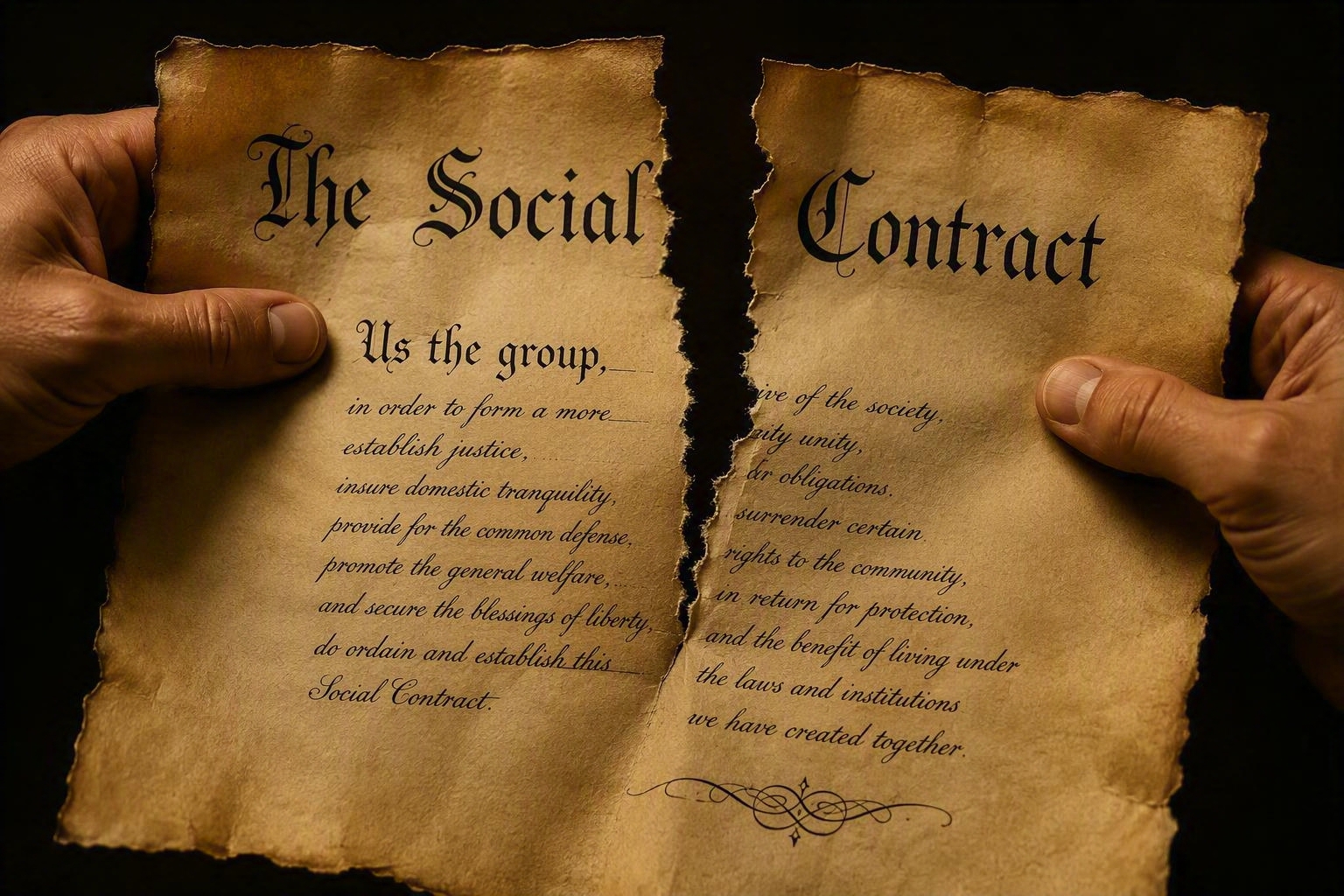
Questions connected this, or topics like it, abound on social media, especially Reddit. Many questions along the lines of “I’m tired of running X-game; what do I do?” or ” I want to change the ruleset, but my players will be upset; how do I tell them?” So today, I want to state it clearly, right from the start, then I’ll elucidate why: GMs get to start and stop whatever they want, whenever they want (and players then can choose to go along with it or not play with that GM).
Pretty much that’s it. I’ll say more, but this is really the crux of the matter – the GM is a person, and as a person, gets to decide how they spend their free-time. There is a social contract in groups, yes; that social contract does not obligate me to run things I don’t like, for certain amounts of time, or to accommodate your particular flavor of game to the detriment of others.
The Weird Gaming Social Contract
Not to belabor the point, but the issues I see people complaining or asking about online seem to stem from some sort of odd, yet silently approved social contract a lot of us have about TTRPGs. Specifically, that one the game starts, it MUST GO ON FOREVER. As always, we can understand why – it’s an investment of time, energy, and even money, to get into a game, set up characters and maintain the stories we all enjoy. Who wants to invest that all again into something else (this of course leads to folks sticking to one game for years, and even a single campaign, even if the steam ran out long ago and they don’t enjoy it). I’d say that social contract is wrong, or at least, needs to be rewritten.
GM = Workhorse
Your average GM getting ready for this week’s campaign session.
First of all, let’s all acknowledge it – the GM does the most work, hands down. There are very few games where all members of the group take on a lot of work to make the game run (in fact, the only one I can think of off the top of my head is Burning Wheel, mostly because most of the bookkeeping during the game is in the players’ hands, and everyone is asked opinions when awarding Fate and Persona points, or during the Trait Vote – these are all explicitly shared burdens, rather than just the province of the GM; but it still isn’t everything). Otherwise, it’s pretty much all on the GM.
For those that don’t know (though…who are you? Why?) GMs do a lot of work to make a game go, even in low prep games. For example, let’s take pre-game prep. At a minimum, GMs spend time imagining what the bad guy NPCs will do, their plans, their resources, etc. Many games require GMs to plan out the opposition for conflicts (mostly fights, but could be social conflicts too). We generally want out games to be a challenge, right? So the GM has to figure out opposition to the PCs that makes sense within the context of the game and the game’s math. Some games need even more planning, like writing up dungeons, or figuring out what Factions do behind the scenes in-between sessions, or other bookkeeping and menial tasks meant to set up the game properly.
During the game itself, GMs run the show – again, at a minimum, they frame scenes, sometimes get said scenes rolling, adjudicate actions between players and the game world, and generally ride herd on the game. They’re coming up with plot or story details (often on the fly), acting as the multitude of NPCs, and describing lots of things in detail verbally or by drawing maps and diagrams.
GMs also often end up as the ones socially responsible, to some degree, about the fun others have. So, if there are personal player disputes outside of their characters (somebody feels another player is unfairly advantaged, or somebody thinks another player is disturbing the game somehow , the GM should take care of them, or any other issues (does a player want a character that doesn’t fit the game? Or somebody is harassing someone else as we play? It’s apparently the GM’s responsibility, to the point that some players will just sit passively as things happen they don’t like, and wait for the GM to signal what they should think or even feel about an at-table issue.
I remember once I had a game with a guy that was racist – he had definite ideas about how minorities in the US should act, and took umbrage when a person at the table didn’t fit whatever was in his head, or didn’t like being assumed to do certain things (as an African-American, and another friend at the table being originally from Vietnam, we took exception to this). I confronted the guy at the table when he started on one of his racist things, and he ended up leaving the game right in the middle. After he was gone, and what shocked me, was that the other players got mad about it – why did I have to make a scene? I just should have told the GM afterwards, they thought. That feels so bizarre to me – I’m an adult, no? I can handle things, and voice if I have a problem (that others may think isn’t a problem anyway).
So it’s a lot of work. For me at least, it’s quite rewarding work, but it IS work. I sometime feel tired after a game, and have even run my voice raw from talking so much.
Why the GM Can Say No
So, if I’m the GM and putting in many more hours of work into a game (as we well know many players only think about the game when they come to the table, and never again until the next session; in my experience it’s rare that players think about the game so much) than anyone else, then, I don’t see why I can’t decide where my effort will go. This isn’t job or a family commitment (and even then, people find ways to wiggle out of something they REALLY don’t want to do). No matter what, I get to decide what I do with my free time, and if I obviously don’t like something (like the game I’m running), I get to bail at a moment’s notice. Is it fair to the others? An excellent question. Communication is key. But as a GM, I reserve the right to change my mind right until we reach the table.
Any Player Can Say No Too, By the Way
This should go without saying but I sometimes feel folks need to be reminded: the GM is a player too. In some groups (and as some now expect) the GM is supposed to bow to whatever the players want (so, if a player wants to play a murder hobo in our Victorian romance game, we’re supposed to accommodate them somehow). But! The GM is also a player in the game, and should also get some things they want. I’m not saying a GM can’t compromise – we don’t want to have the GM control our characters or railroad us in a game that essentially boils down to the GM roleplays by themselves for four hours while we watch (I’ve actually had that happen to me as a player once; sort of the lead up to Forever GM-ing). So, in some groups, the GM is in a weirdly subservient role, meant to “facilitate” the players’ fun (while neglecting their own). That’s just wrong-headed. The GM is a player in the game; they have different tools and pieces, but in the end, they’re still also playing the game, and presumably get some sort of enjoyment from the experience. Or at least they should.
This also means, of course, players can, and do, say no to playing something they’re not interested in. I know there are players that stay in a group for a game they’re not really feeling for lots of reasons: they just want to hang out, their friends are in the group, they think it’s the “only game in town”. I just think it bears saying that as a player, GMs don’t have to hang around. Yes, this game ends if the GM stops wanting to play (unless someone else picks up the mantle to run it), but they don’t have an obligation to be there, just like no one else does.
GMs are Human (and thus, make mistakes)
For my final point, I also want to remind people out there that, simply, GMs are people; they make mistakes. So, I take a long time to evaluate a system, and whether it’s right for a game I want to run. I ask question on forum, make a bunch of test characters to understand character generation. I sometimes even do a test run of the conflict systems. I listen to Actual Plays and read them as well. And yet, after all that, we can get a game to the table and it falls on its face in a way that makes me feel bad. Yes, of course, some of that may be unfamiliarity, but some of it is simply, this doesn’t work as I thought it would. As I mentioned elsewhere, I’ve often started a game in one system, and realized I needed more detail or some capability that this system doesn’t offer, but another does. I recently migrated a Viking England game from Fate to Burning Wheel, and after one session I already feel the game is better for it. Fate is a fine system, but BW fits better what I’m trying to do.
Which is a long-winded way of saying, sometimes the GM choose wrongly. We play a session or three and we know, down in our bones, the game is wrong for us, or for the table, or for society at large. We realize we don’t have time to commit to this system, or maybe it just doesn’t work the way we’d imagined in our heads. And so we want to bow out or change it. Or maybe we’re just bored – we thought yet another campaign of Your-Always-Game would be fine, and then it turned out no, really, I can’t stand it anymore.
So…GMs can Change Games? Or Even Drop Them?
Yes. A GM can bow out and do something else. It’s your time GMs. Maybe you feel like compromising on a game, maybe not. Maybe this decision will push your players away. Maybe you’ll decide to give up GMing all together. It happens. But if you’re not having fun in a game, during your free time, why are you doing it? Don’t!