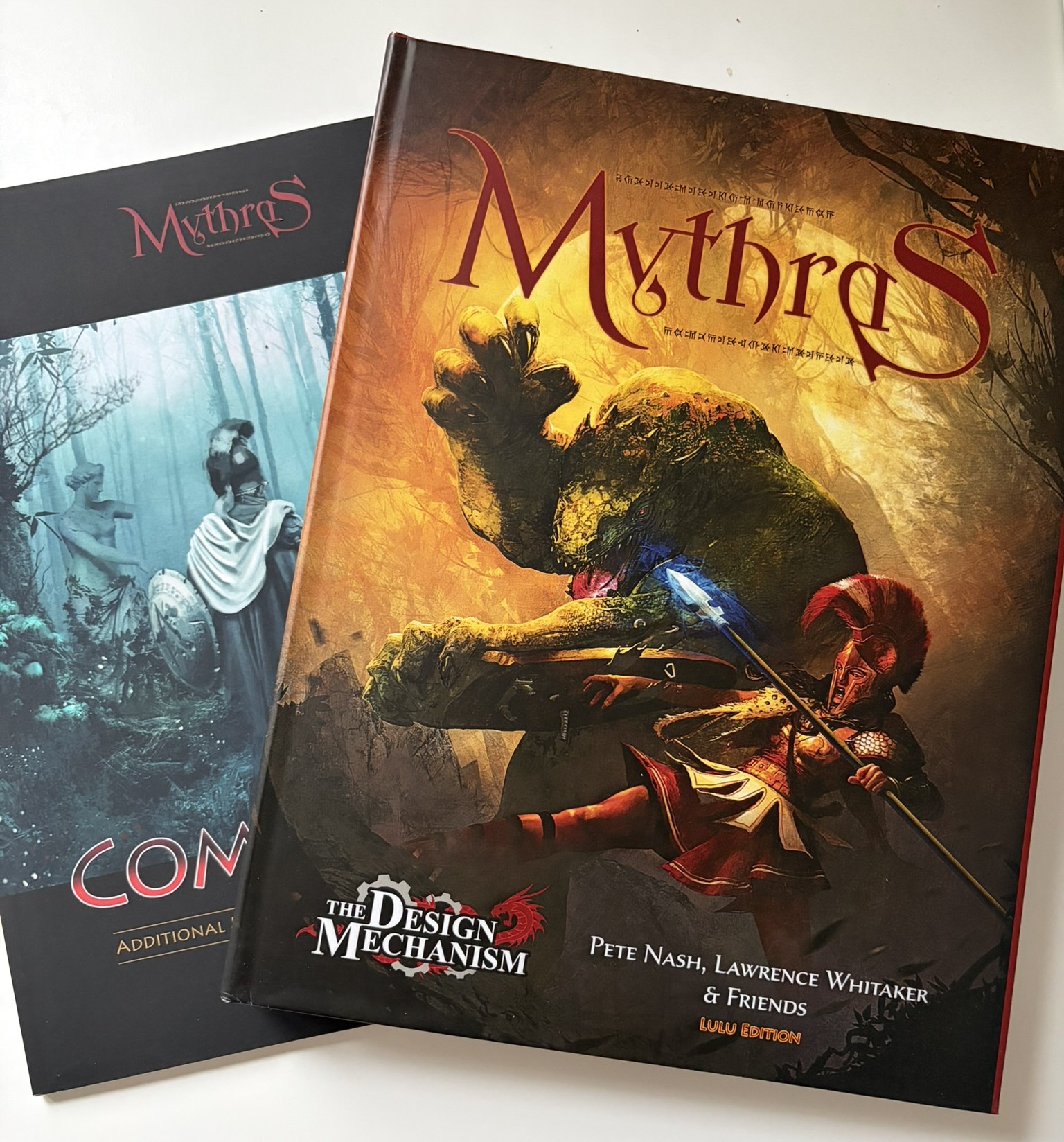
This one is long (you’ve been warned):
Mythras is an interesting animal to review. On the one hand, it’s obviously derivative of Basic Roleplaying (and it’s first incarnation was called Runequest 6 even, so the DNA is obvious), so a lot of what I said I liked about BRP here holds true for Mythras as well (and indeed, that’s how I ended up running it in the first place). On the other hand, Mythras does some things quite differently than base BRP, and those differences make it interesting to examine.
So, in this review, I don’t want to rehash the similarities between the games. For example, both use percentile, there’s an extensive skill list, both games lean more “realistic” in terms of, say, low or historical fantasy (my favorite genres so you can see my easy interest), and both handle advancement through Experience Rolls (though a bit differently, as I’ll get into below). I have a pretty long shelf of Mythras stuff, and it’s time I talked about it since the game figures heavily in my consciousness (and the gaming table).
What is Mythras?
Again, I don’t want to belabor the point, but Mythras is a direct outcropping of BRP. I’d personally go so far as to say that Mythras is an extensive rewrite and refocus of BRP, except it was made by two people who were not part of Chaosium, and were approaching things from their own needs and wants in a game system. And it incorporated things from other games the writers had been involved with, so, I take it back. Mythras is a game that has its roots in BRP, but the foundation has moved a bit, though still contains many of the strengths of that system, and has added its own to boot.
The two creators of the company that publishes Mythras, Lawrence Whitaker and Pete Nash of the Design Mechanism, did work on various d100 based games, including the old Runequest II line from Mongoose). They published Runequest 6th back in 2012, based on their design ideas from the Mongoose work they did (and another game published around them by them, called Legend). That game, once Moon Design Publications took control of Chaoisum (the holder of the Runequest IP) was set adrift in a sense, so the Design Mechanism rebrand it as Mythras.
What is Mythras Focused On?
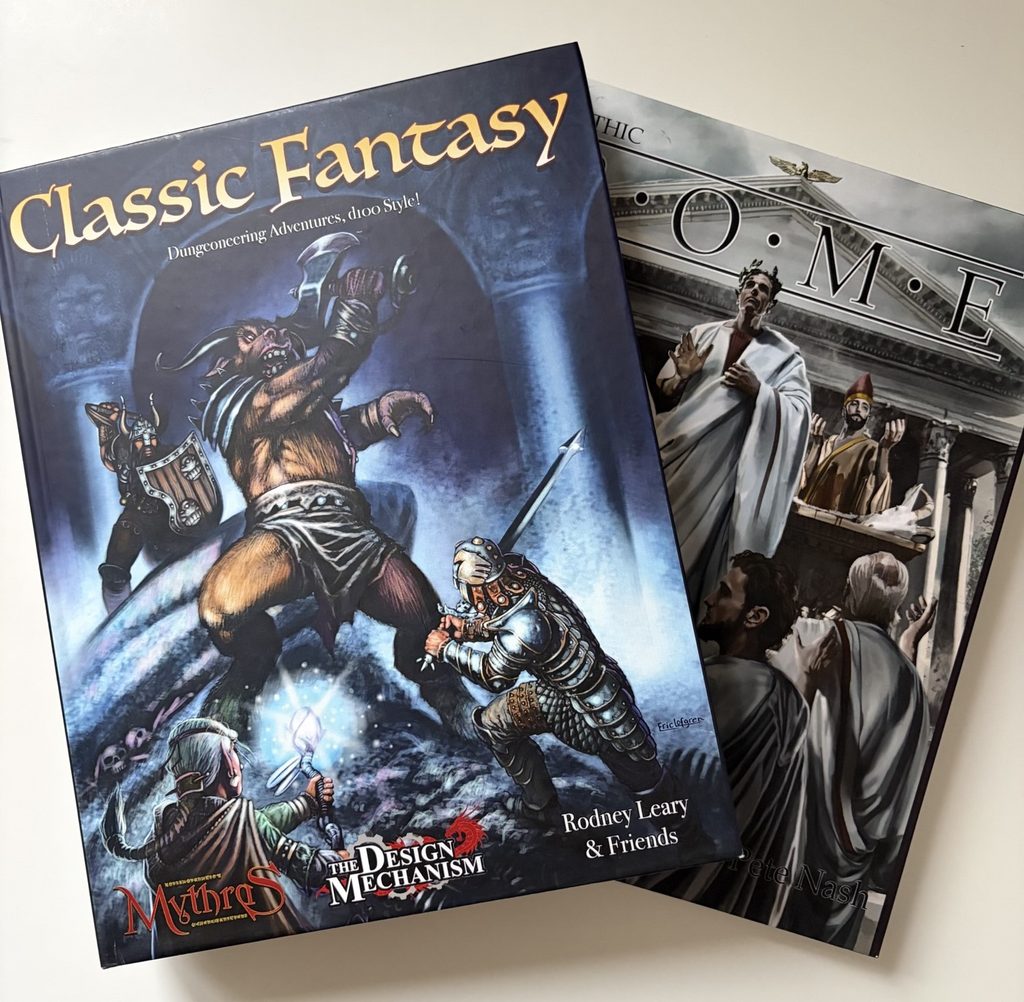
This is my opinion, so, I’m sure the authors themselves have said more on this, but for me, Mythras is focused on the historical and fantasy genres. The system has since then been stretched to do a lot of other things (from Science Fiction to Supers) but I still think the main focus is that historical-ness. In fact, many of their supplements (and there’s quite a library of them) are focused on taking a historical setting and adding magic and myth to it. Called the Mythic series, these tomes are usually pretty well researched, and give plenty of hooks and other ideas for any gaming table. I can confidently say, that picking up any of these books will give you enough history and other bits and bobs to easily run a campaign from it.
With that out of the way, let’s talk about the differences Mythras has from “standard” BRP (or at least, what most versions seem to be). I’ll also mention where Mythras and BRP converge (there’s a lot of this).
Special Effects
This is the secret sauce that makes Mythras run, and as far as I’m concerned, one of the main reasons to run it. Basically, Special Effects happen when you make a skill roll in one of the conflict systems (so, combat in the core book, or social conflicts in the Mythras Companion), and you compare your roll to the opposition’s roll, and then see the final level of success. So, for example, if I roll a Critical Success to strike my enemy and they roll a simple Success to block me, then I’ve rolled a higher level of success and earned myself a Special Effect.
What Special Effects you can choose depend on what conflict system you’re using (so combat Special Effects are not the same as, say, the Special Effects used in the Factions book or the Mass Combat system). What makes them so interesting is that, in combat, they solve an interesting problem, or rather, a problem of doing interesting things?
What I mean is, in combat for example, let’s say you want to disarm your opponent; you have good narrative reasons to do so, but the two of you are in a fight. In general, for many games, you would declare your intention to disarm. The GM assigns a difficulty to doing so, you roll and hope you didn’t waste your turn if it fails. In other games, you might not be even able to do it unless you have the right Feat/Talent/Technique or whatever, and you’ll probably STILL be penalized for trying.
Mythras’s Special Effects system changes this. Instead of declaring your intent to disarm and then rolling, you roll first (so you DO declare you want to attack them, anyway) and if your success is more successful than the opponent’s, you can look at the list and if you qualify (some Special Effects have requirements, like having rolled a Critical or even something specific like having attacked with a firearm) then you can choose Disarm. The opponent might get a reaction/resistance roll of some kind (Disarm triggers this, for example) but in general, you get what you choose. For example, if you succeed at your roll and pick Choose Location, you can “aim for the head” and that’s what will happen.
This means that basically, for most rolls in combat (or any of the conflict systems) something interesting will happen. Because Mythras doesn’t really have Feats/Edges or anything, neither the player, nor GMs need to “build” what I can trick characters (for example, a character that is built around the idea of Stun/Locking people). Those builds can’t happen, and conversely, everyone has access to that sort of thing if they manage to get a level of success against their opponent. It also means the GM doesn’t need to adjudicate how various Talents or what have you interact with each other (a major headache avoided).
The Special Effect system does one other special thing. In combat at least, you don’t have to fight to the death. There are Special Effects for disarming your opponent, or even getting them to Surrender.
Of course, after signing it’s praises, Special Effects do have a problem – it’s going to take time for you and your players to learn. There are a LOT of them for combat. The other systems that use them (social conflict, mass combat and faction actions) have shorter lists, but still, things to read and learn, which take time and mental bandwidth.
Character Creation Focuses on Community
Remember back in my other article I said I like games that foster community (and BRP does), Mythras does too, but really dives into the idea. Character creation here is a step-by-step process, and each step is tied to some part of your life. For example, when you start picking skills, you first do so based on your background (say, born in a city or in a barbarian tribe), then you allocate skill points again in terms of your profession. Finally, you get some bonus skill points to represent what you’ve bene doing and what you’re good at. Which means you’re already tied more to the communities you are a part of, since we at least try to identify which ones shaped you as a person. At the end, all Mythras books let you roll for life events or some such that will give you extra story hooks and what not for the GM to play with.
Skills are Arranged and Calculated Differently, Kinda
So, Mythras is a percentile system just like standard BRP. One interesting difference though is that Mythras splits skills into two categories: Standard and Professional. I think the idea of Standard skills is quite clever – basically, these are skills that absolutely everyone has some skill with, things like speaking their native language, or understanding their native customs (it’s quite a long list, actually). Next to that are Professional skills, which are skills that require some kind of training or expertise to attempt (so, knowing about your own culture’s customs is a Standard skill since you grew up with them, but knowing them about other cultures is something you have to learn, and thus, a Professional skill.
Also, the way Mythras handles calculating starting skills is interesting, and also has the added bonus of making Characteristics more important (and thus, creating a situation where there are no dump stats). In Mythras, all Standard skills, and any skills you choose as Professional skills, start at a rating usually equal to two of your statistics (so, they might be Strength and Dexterity, Intelligence and Charisma, or even Dexterity times 2 or something like that). I really like this, and wish BRP itself did something like this (there is an optional rule in BRP, adding a Skill Category Bonus based on your skills, which sort of like Mythras’s rule but not really since the bonuses aren’t usually that big (average of 0-3%).
Experience Rolls are Different
This is a slight difference but it does bear mentioning. In Mythras, at the end of a session, instead of looking at which skills you used in the session and rolling to see if each skill goes up, you gain a number of Experience Rolls given by the GM (modified slightly by your Charisma – the idea being, if people hate or like you more, you’ll have more interesting experiences, or people willing to nudge you along, I guess?). This is interesting because it means that you don’t only roll to increase skills you used during the session, but you can spend these Experience Rolls to increase any of your skills, or to even buy new skills. You can also use Experience Rolls to buy new spells if you’re a sorcerer or spell-casting priest, for example.
Hit Locations are the Default Rules
This is one of the few places I’m not in agreement with Mythras (though to be fair, several BRP games use this too). Hit locations of course refer to the fact that in combat, when rolling to hit and damage, that you’re actually hitting a particular part of the body (which will have it’s own armor rating depending) and you do damage to that part, and not the whole. What’s slightly different than some BRP variants of this is that there’s no “overall” hit points – in some BRP games, if you take, say, three points of damage to your arm, you ALSO take three points of damage to your overall HP. Mythras treats them separately, and you can only die instantly when you get a Wound that pushes you into negative territory, in your Chest, Abdomen or Head (and after failing an Endurance roll to resist). Interestingly, this makes characters a little tougher than in the BRP system I described above, because you COULD get hit in your limbs, which while it’s bad to have a Major Wound there, it won’t lead to quick death (only if, after some minutes, you bleed out).
So, in a weird way, while I usually don’t like Hit Location systems in games, Mythras gets a pass since the system can lead to a character being quickly knocked out of a fight (by falling unconscious because of limb damage), but not necessarily being killed. In the games I’ve run of it, this means I’ve had players dive into a fight they shouldn’t, get badly hurt, but not killed for it, so they’re a little more likely to be brave and try something dangerous later. A small but noticeable behavior change.
Cults, Yeah, but Brotherhoods, Mercenary Companies…
In most of the editions of Runequest, especially those that centered on Glorantha, the original fantasy world of Runequest, characters could be members of a cult, and organization centered around a god/goddess and that allowed you to be part of a certain community of believers, and for people more devoted, to gain magic and other power as you raised your skills and showed even more devotion.
Mythras took this idea a step further and allows everyone to belong to some sort of organization, not just magic users or priests. The GM or player could create a merchant’s guild, or a wizard’s hall, or whatever, assign it skills members should know at various levels and other benefits as you move through the ranks. I think this is a really great tie back into the community theme I love so well, and it means your character also has something to strive for other than wealth from adventuring or whatever.
There’s More to Say But…
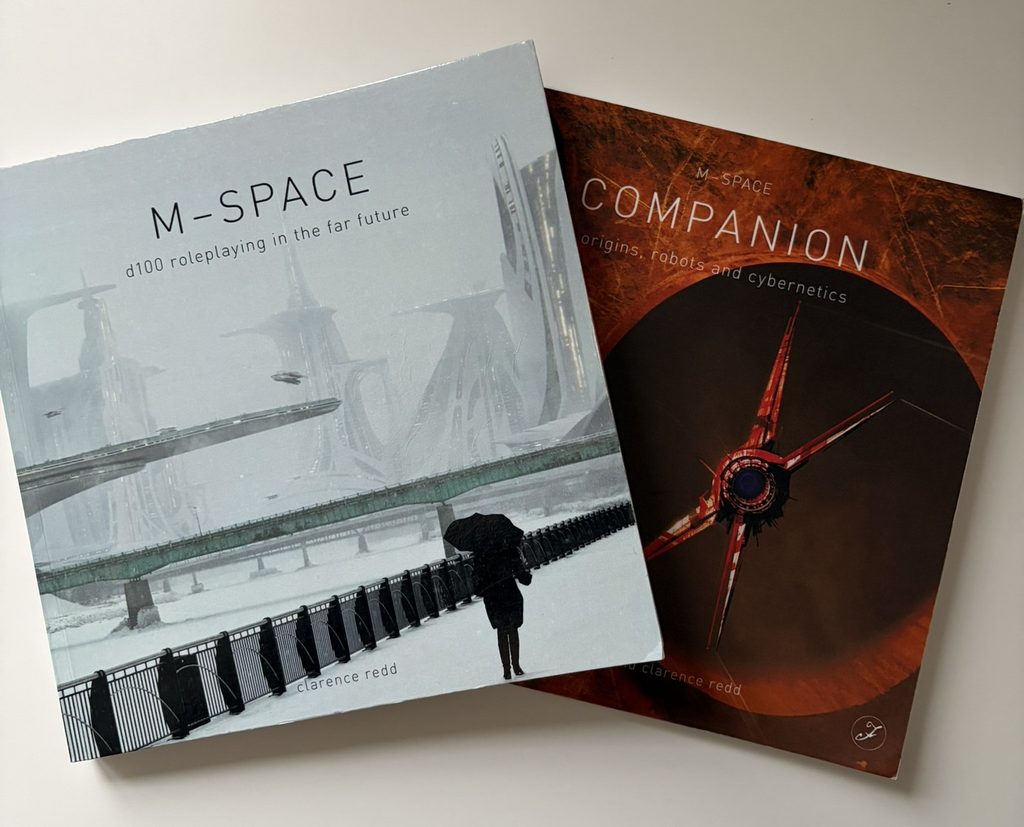
As always, there’s a lot more to be said, because Mythras is a bit crunchier than BRP, so there’s lots of smaller, mechanical differences that also add up in making this game unique. Overall, I quite like it, and I really only have quibbles with two things: 1. The default of using Hit Locations (M-Space, a science fiction ruleset for Mythras, gives the option not to use them and have General HP instead, but otherwise, I’d have to refer to BRP for General HP, though since it’s a d100 game, its eminently doable) and 2. A mass combat system that isn’t QUITE what I want. Past that, I love it, and it enjoys rotation at my table every now and then.
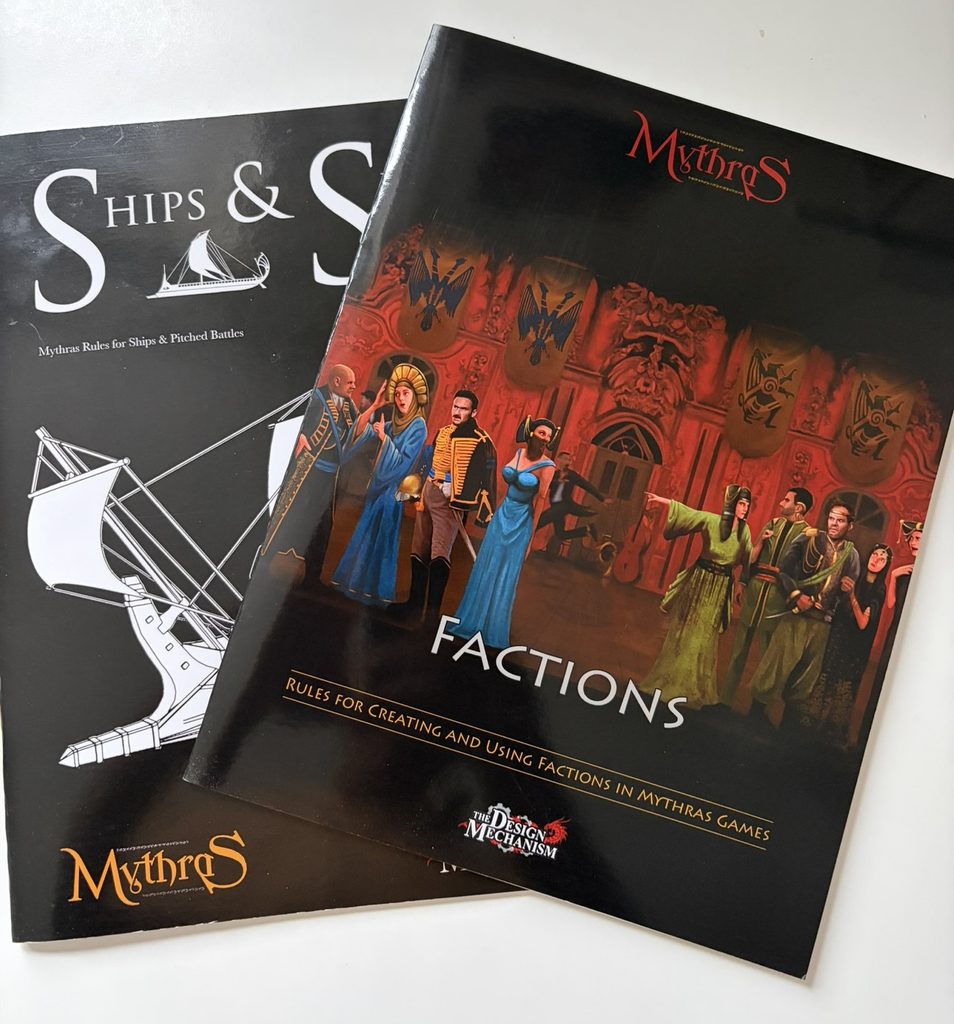
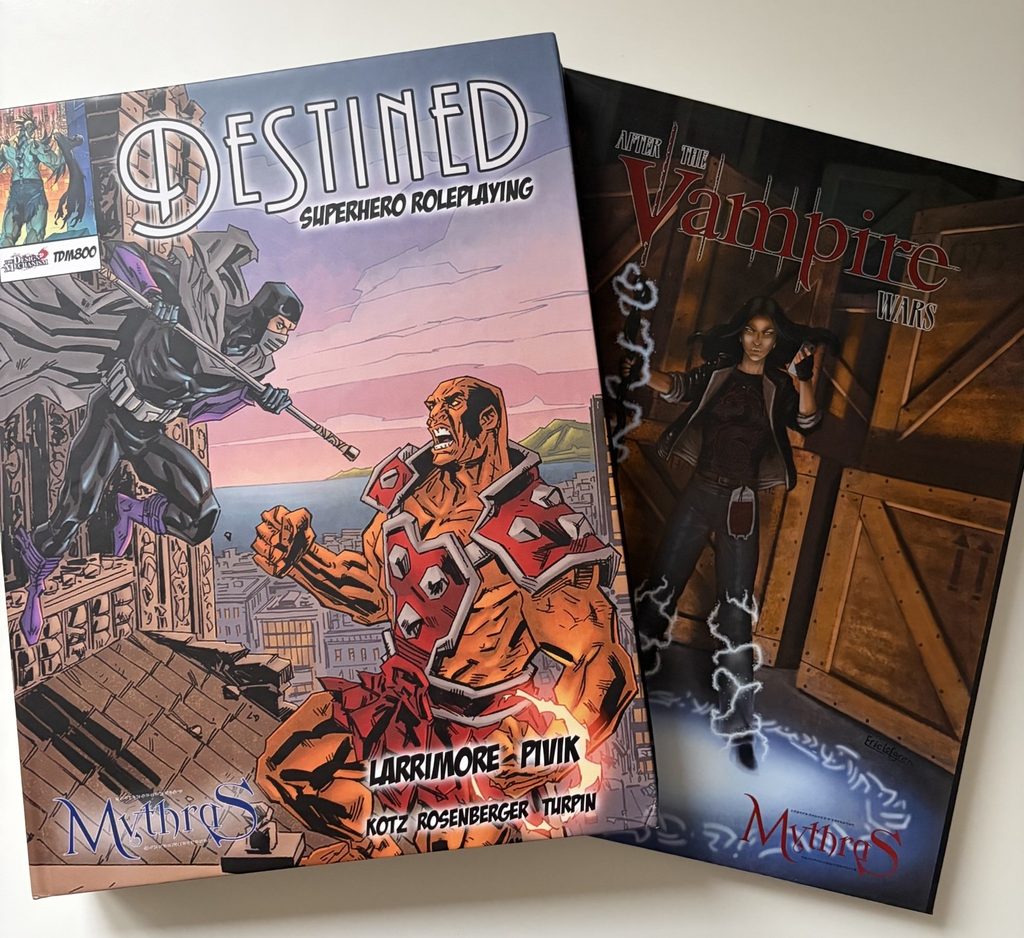
Another advantage for Mythras is that, in the years since it came out, it has a large library of books, with my favorites being the rules supplements (like M-Space for science fiction and Destined for supers) and the Mythic Earth series (books showing a “mythic” versions of our own world, like Rome, Babylon, and a sort of Arthurian England (but more history, less knightly fantasy).
Let’s not forget the ORC License! This is a license where, within certain limits, anyone can publish material for Mythras. BRP, I should note, is also part of this initiative. So this could be a good choice if you’re looking to publish something and your idea fits BRP or Mythras, for example.