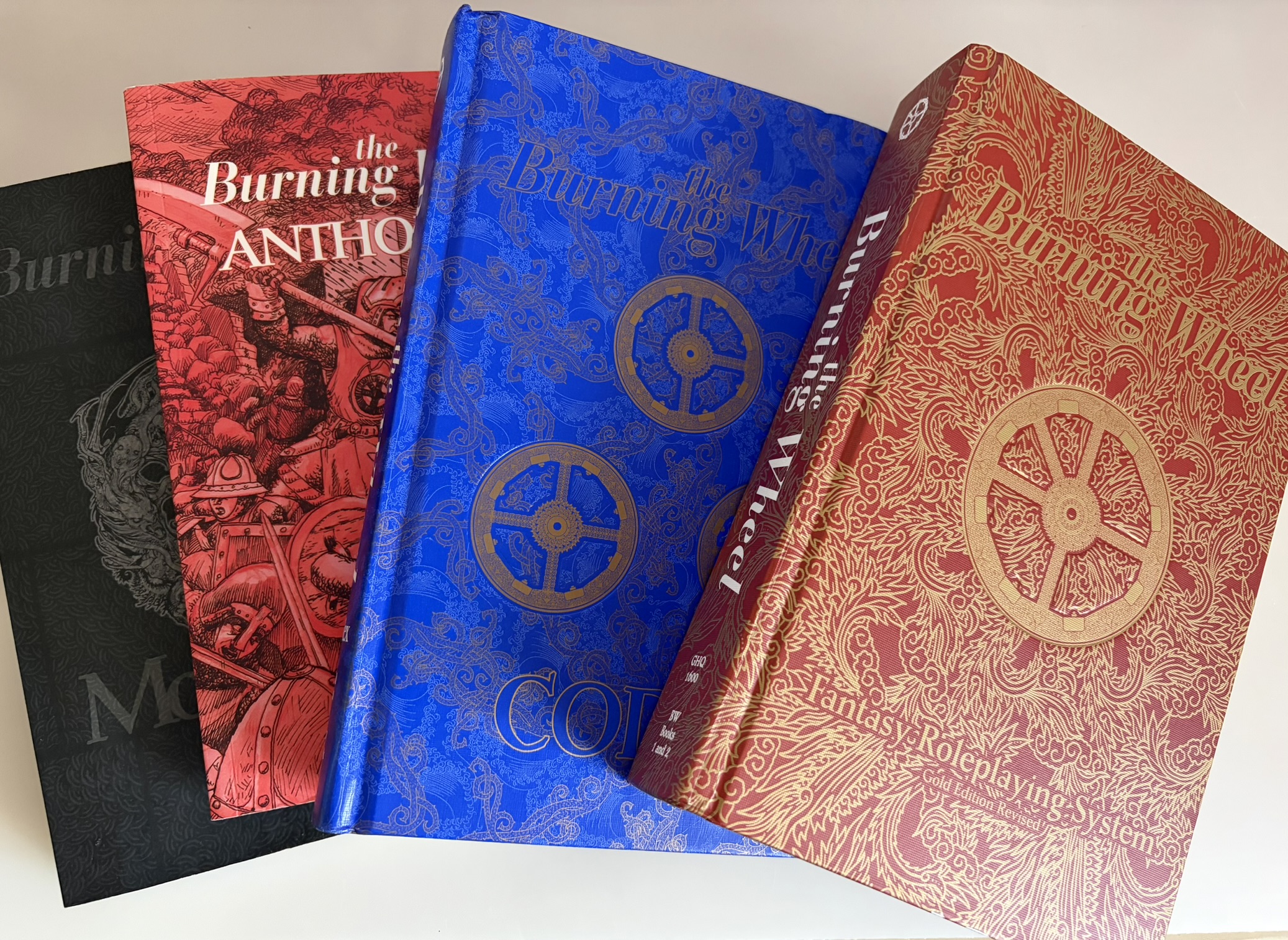
This article has been a long time coming, and frankly, is going to be a two-parter as I have a lot to say and plan to wax lyrical while doing so.
You see, in a lot of ways, Burning Wheel is my “perfect” game; the author thinks about gaming things the way I do, and if I had any ambition to be a game designer, this is the game I’d want to have made. It does something weird which I think still isn’t done enough in TTRPG game design spaces: it says the game is character driven, and gives that part rules, but also make those rules crunchy, while tying them to several interconnected systems. I can’t think of any game that does this off the top of my head (the current incarnation of Savage Worlds sort of does, since it’s a pretty traditional game but has character focused elements sprinkled in like Interludes, or ways to turn the game from task-rolling to scene-rolling with its Dramatic Tasks and Quick Encounters – something I ought to write about later…).
Anyway, this is one of the many things that makes BW sort of unique – it scratches my itch for crunchy games and also lets me have my character focused story-game as well, and makes it all work. It also does a bunch of other stuff that, for example, remind me of both GURPS and Fate as systems, but also does things in ways those two games don’t. If BW ever made a pure science fiction version (Burning Empires is great, but takes work to make it generic for other science fiction), I wouldn’t play anything else.
So, I’m going to write about the game that I had a weird love/hate relationship, that has slowly turned to like and then respect as time has worn on. This is also a bit self-serving, as I’m running a BW game now (just started a few days ago) which has its own weird story since I’m switching to it from another system (from Fate, actually, as I’ve mentioned in my previous article about crunchy games).
One more caveat – this isn’t going to be a review in the traditional sense. I’m not going to necessarily talk about what’s on each page and such not. More, I’m going to talk about why I keep falling back to this game, why I feel I have some of my best GM game ideas when thinking of them in BW terms, and why I keep comparing other games I play or run to it. This isn’t to say the game is perfect – it definitely isn’t, and has plenty of little things that have annoyed the various groups I’ve foisted this thing on and myself into selling the game away TWICE before finally turning to the light. So, it’s an odd beast, and one that has made me evolve (or was where I eventually wanted to be).
Okay, but what is it?
If you want a basic rundown, there are a whole bunch of reviews about BW in all its various editions. The latest is Burning Wheel Gold Revised (I almost expect the next iteration to be called BW Gold Revised Revised),. There are also a stable of games that have come after it, some not in print really (like Burning Empires, which made me absolutely a better GM, but more on that later) and some that definitely area and in their second editions even (Torchbearer and Mouse Guard). There are some other games BWHQ print (like Freemarket and the very new Interceptor), but frankly, I don’t know much about them and so can’t say anything intelligent thereof.
So what is it? Burning Wheel is a fantasy game that does things in an odd way, because its take on fantasy is a bit off compared to quite a lot of other games. First off, it’s fantasy, but lends itself to low fantasy, but can scale up to an extent and, perhaps, capable of high magic fantasy. It can go as low as realism, and is one of a handful of games I’d recommend for a more historical approach to a game (the others being GURPS, Mythras and BRP). While it’s doing that, it’s also a character-driven arrow aimed at whatever the players decide is important.
Beliefs, Instincts and Traits
These three things (called BITs) are the arrow I’m talking about, and what has me gushing about this game, and more importantly, make my job as GM very easy. Beliefs are things that your character believes in, and will do something active about (so if it’s a Belief, it’s not just something you think or feel is true, it’s something you’re going to make sure happens in the world). Next to those, Instincts are things your character always does (because of what kind of person they are). Lastly are Traits, which are a lot of things that can help you do different actions, but are also ways to play your character.
For example, imagine you have a knight with the Belief “The Church is in danger from the heathens; I’ll evict them from my Lord’s lands.” That tell us two things: 1. this knight thinks the Church is being overrun and; 2. he blames the heathens and is going to kick them out from his Lord’s lands because of it. For the GM, this means your job is to set up heathens doing heathen things for them to get mad about. But you can twist – maybe make an important persona heathen, so it’s not easy to get at him, or make a heathen sympathetic in some way, so evicting them hurts.
An Instinct might be “Never say no to a fellow villager in need.” As a GM, this tell me to make sure the village is in danger sometimes, and that this player wants problems when trying to save people from his hometown. It’s also good because the character will generate Fate or Persona based on how they played up the trouble caused by the Instinct.
Traits are the odd duck here. On one hand, a Trait might be as simple as “Lazy,” meaning your character (or at least people around him think) he’s lazy and unproductive. If you play that Trait in a way that gets them in trouble (say, handing the McGuffin to someone else to carry because you don’t want to, and they end up stealing it) then you generate Fate for the character. It also might do something dice (like adding to rolls) or even allow you to reroll dice or break ties. But even in those cases, it STILL acts as a thing you can play. For example, if your character is Gifted (which allows you to cast magic) it might also be that Gifted people are suspected of being dangerous to society, and so being known as Gifted can get you in trouble, too.
These sorts of things (created by the player) give me plenty to do as a GM, and get players invested in what’s happening. Mind you, it takes a certain sort of player to get into it – the player has to be the sort that has some vague ideas at least of how they want to interact with the game’s situation, and what they might want from it for their character (which might me they have to take a bit of an authorial stance on the whole thing, thinking like a writer).
Why That’s Interesting (Big wheel keep on turnin…)
Now, none of this is unique to this game. Fate and to an extent Cortex Prime can ask the same thing of players. The difference for me lies in the execution – BW ties BITs into how you gain Fate and Persona points (which can be used to increase success chances amongst other things), which also ties into advancement of your stats and skills (there are cases, to get certain kinds of advancement Tests, you NEED Fate or Persona to go for it). Off the top of my head I don’t know any game that really does this in this way, so neatly tied together as it is.
Anyway, that’s Part One. There’s MUCH more to discuss, but that needs a Part Two (coming soon!) as this has already run pretty lengthy.
As always, there are more articles that I’ve written, which you can have a look at here: Articles
Leave a Reply